A dose of ionizing radiation of just 5 to 10 Gray (Gy) is lethal to a human, as it irreversibly fragments our DNA. However, there is a microscopic organism capable of shrugging off 15,000 Gy without mutating or losing viability: the bacterium Deinococcus radiodurans, originally discovered in the 1950s inside a can of meat sterilized with gamma rays.
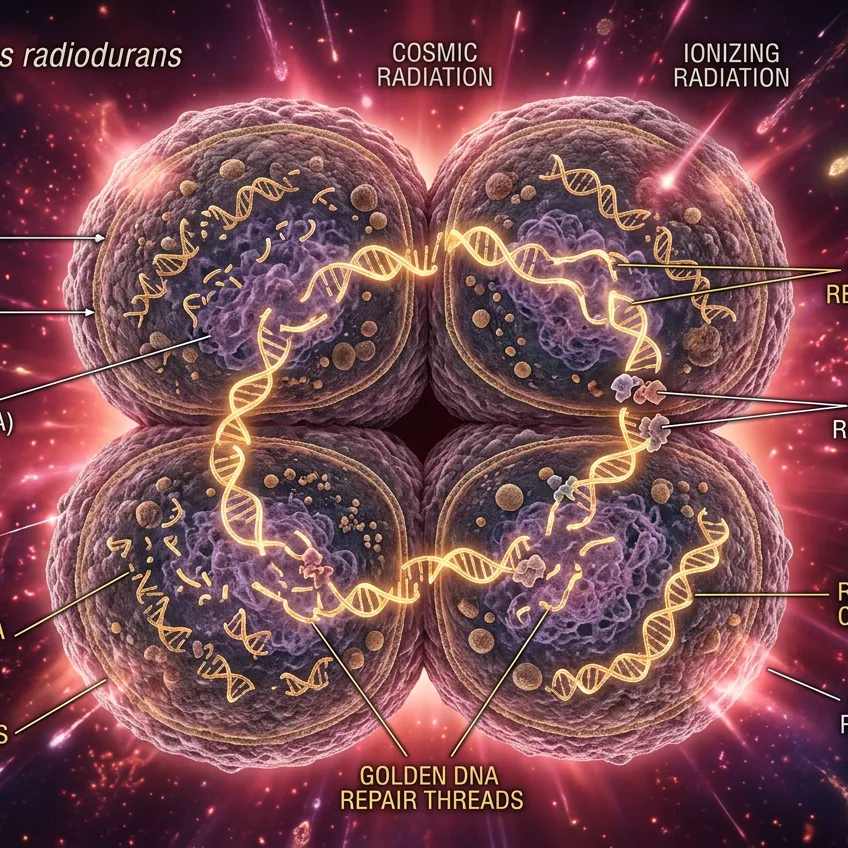
For decades, biologists believed that its genome must be immune to physical breaks. The reality turned out to be much more astonishing: radiation pulverizes its chromosomes into hundreds of disconnected pieces, just as it would happen to any other cell. Its real secret lies in protecting the repair machinery rather than the DNA itself.
Research led by biochemist Michael Daly revealed that D. radiodurans accumulates massive concentrations of manganese antioxidant complexes. These compounds act as an insurmountable chemical shield that instantly neutralizes the free radicals generated by radiation, preventing them from oxidizing or denaturing its enzymes.
Thanks to this protein shielding, its repair enzymes (especially the recombinase RecA) remain intact. In a matter of 12 to 24 hours, they assemble the scattered chromosomal fragments as if solving a perfect three-dimensional puzzle, using a toroidal genomic structure that keeps the pieces aligned to restore the original genetic code without flaws.
Source: Nature Reviews Microbiology / Daly, M. J. et al. (Accumulation of Mn(II) complexes protects proteins in Deinococcus radiodurans)