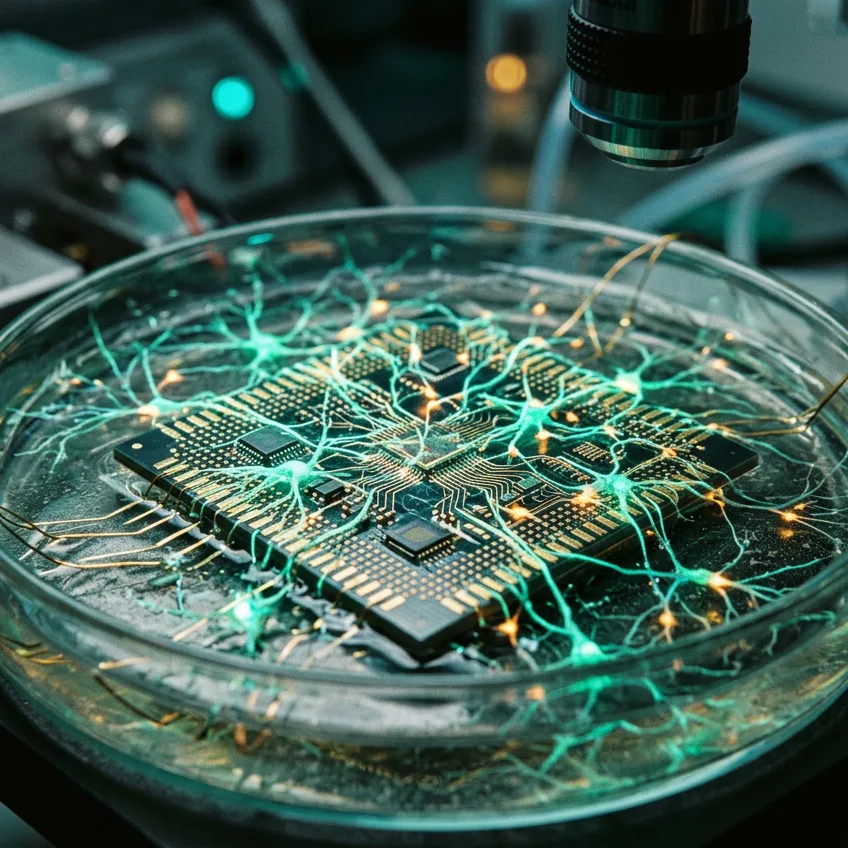
In 2022, a team of scientists led by the biotech company Cortical Labs in Melbourne, Australia, achieved a revolutionary breakthrough at the intersection of neurology and computer science: they created DishBrain, a hybrid system composed of about 800,000 living biological neurons cultured on a silicon microelectrode array, capable of learning to play the classic arcade video game Pong.
Unlike conventional artificial intelligence, which processes mathematical algorithms within silicon chips, DishBrain used living tissue—derived from human stem cells and mouse embryos—. The device connected the neurons to a virtual environment using electrical signals:
- Sensory feedback: The electrodes stimulated specific areas of the culture to indicate the location of the virtual ball.
- Motor control: The electrical activity generated collectively by the neurons themselves moved the paddle up or down.
- Free energy principle: When the paddle hit the ball, the neurons received a predictable and orderly stimulus; if they missed, they were sent a chaotic and unpredictable burst of electrical noise. To avoid uncertainty, the neurons self-organized in just five minutes to hit the ball.
DishBrain demonstrated for the first time the existence of synthetic biological intelligence with real-time adaptive learning, opening the door to ultrasensitive biocomputers that consume a fraction of the power required by modern supercomputers.
Source: Neuron (Cell Press) / Cortical Labs (2022): 'In vitro neurons learn and exhibit sentience when embodied in a simulated game-world'