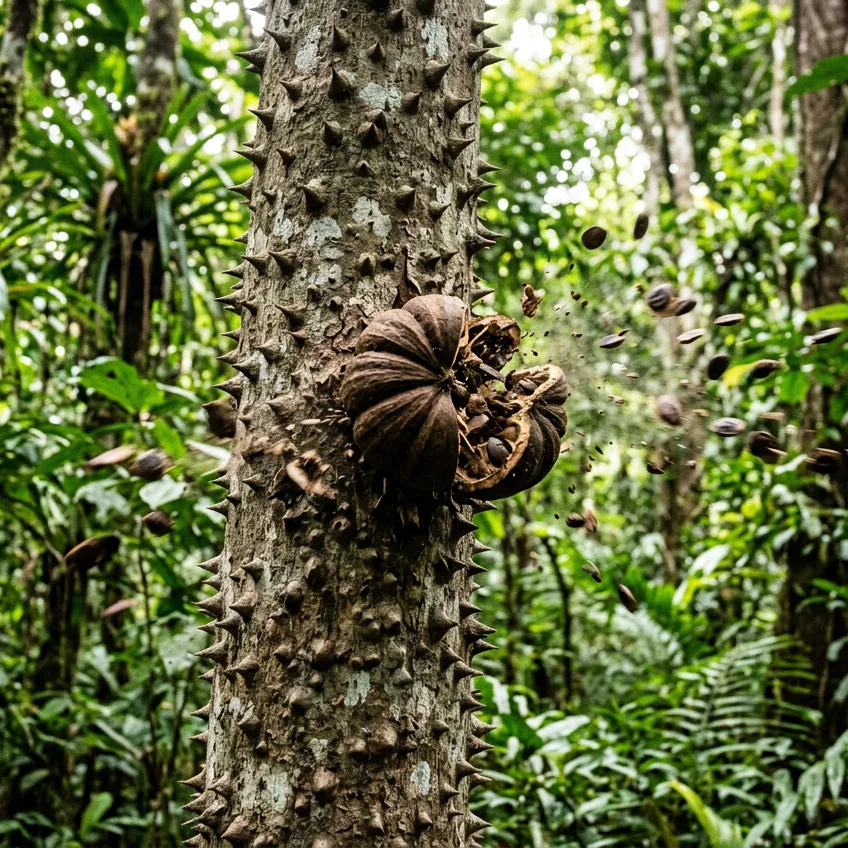
In the dense tropical forests of the Americas lives a botanical colossus that seems designed as biological weaponry: Hura crepitans, popularly known as the "dynamite tree" or "sandbox tree." Reaching up to sixty meters in height, its trunk is completely covered by a dense armor of sharp, conical thorns. However, its most extraordinary and violent adaptation lies not in its bark, but in the explosive physics of its fruits.
The woody capsules, resembling small segmented pumpkins, undergo millimetric differential drying as they mature. This asymmetrical loss of moisture generates colossal elastic tension among the different tissues of its carpels. When the wood can no longer contain the accumulated energy, the fruit undergoes an instantaneous chain fracture termed mechanical ballochory.
The result is a sharp detonation that sounds exactly like a gunshot and produces astonishing ballistic effects:
- It expels the disc-shaped seeds at speeds of up to 250 km/h (approximately 70 meters per second).
- It hurls the plant projectiles to distances of more than 45 meters from the parent trunk, ensuring that saplings grow far from parental shade.
- It generates woody shrapnel capable of seriously injuring unsuspecting animals or people within its blast radius.
As if this biological cannon were not enough, the tree's milky sap is laden with huratoxin, a caustic compound that causes immediate blindness upon eye contact and was historically used by Carib tribes to poison the tips of their hunting arrows.
Source: American Journal of Botany (studies on ballochoric dispersal in Euphorbiaceae)