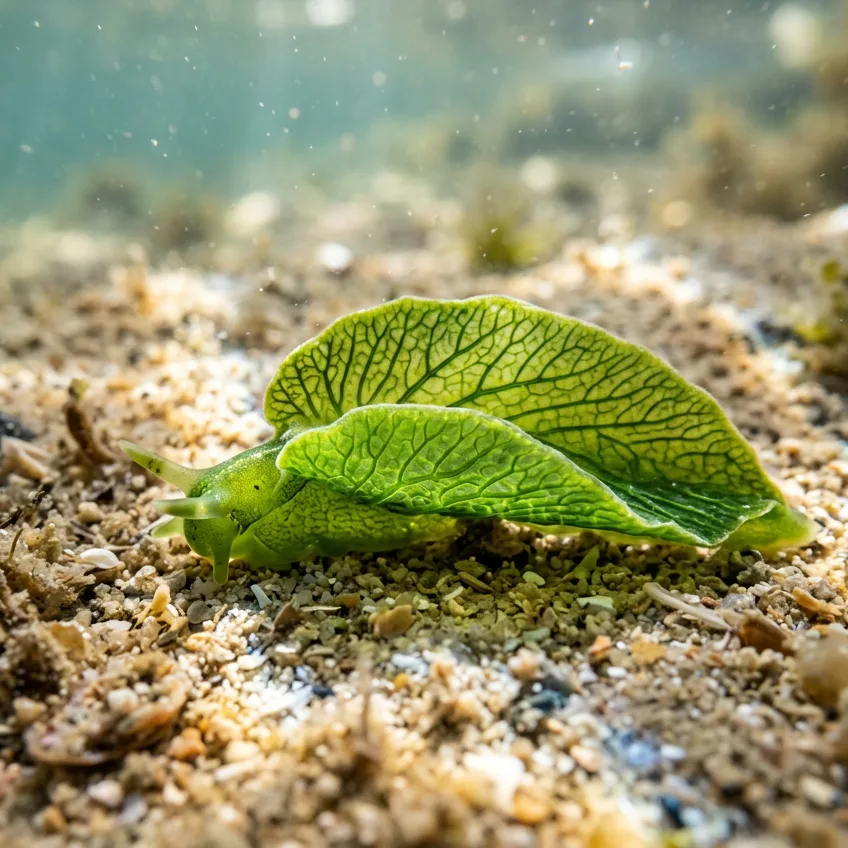
In the salt marshes of the east coast of North America lives an invertebrate that seems to have blurred the boundary between fauna and flora: Elysia chlorotica. At first glance, this emerald-colored creature looks like a sea leaf gently gliding along, but it is actually a sea slug endowed with an almost magical ability: it can feed exclusively on sunlight for months.
The secret of its metabolism lies in kleptoplasty, a biological process through which the animal hijacks functional organelles from its food. The slug pierces the cells of the intertidal alga Vaucheria litorea with its radula and sucks out their contents, but instead of fully digesting the plant matter, it carefully extracts intact chloroplasts and embeds them inside the cells lining its own branching digestive system.
Once integrated, these photosynthetic organelles remain active in the mollusk's tissue for nine to ten months. During this time, the slug produces glucose and amino acids from water, carbon dioxide, and sunlight, staying nourished and healthy without needing to ingest a single solid calorie for the rest of its adult life.
For years, scientists debated whether this marvel involved horizontal gene transfer from the alga to the slug's nucleus to synthesize chloroplast maintenance proteins. Although recent genetic studies suggest that the chloroplasts of this particular alga are unusually robust, Elysia chlorotica remains the most extraordinary paradigm of direct solar energy successfully adopted by a higher animal.
Source: Proceedings of the National Academy of Sciences (PNAS)