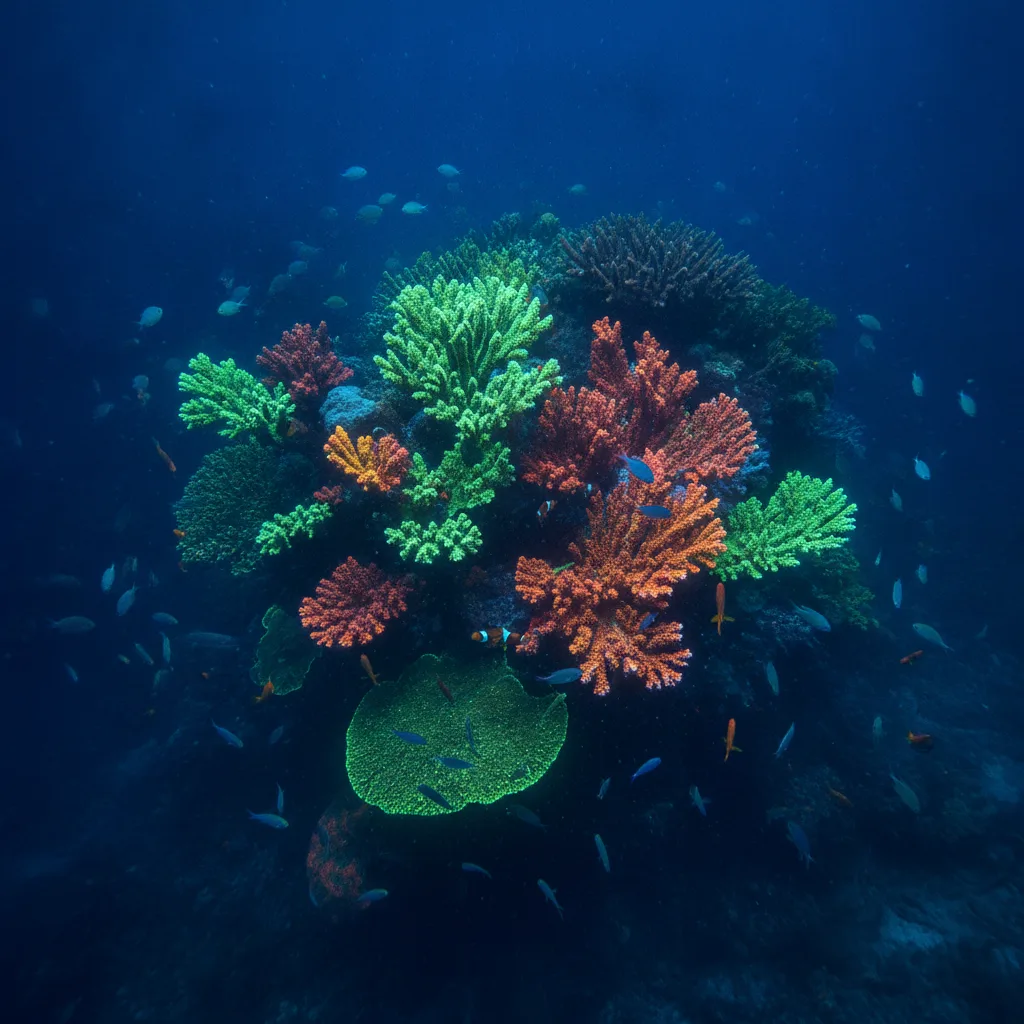
In the blue depths of the ocean, where sunlight filters through and becomes diffuse, corals not only survive but thrive with an astonishing optical trick: biofluorescence. Unlike bioluminescence, which is the production of an organism's own light, biofluorescence is the process in which corals absorb the blue light that still penetrates the water and re-emit it in vibrant, warm colors, such as greens, reds, and oranges. It is as if each coral carried a natural spotlight that transforms the darkness into a neon festival.
This phenomenon is made possible by special proteins present in coral tissues. When photons of blue light, which penetrate water best at certain depths, strike these proteins, their energy is absorbed and then released at a different, longer wavelength, which we perceive as those glowing colors. Scientists believe this ability serves multiple vital functions. One of the most widely accepted is protection against UV radiation, acting as a 'sunscreen' for the photosynthetic algae (zooxanthellae) that live in symbiosis within the corals and are crucial for their nutrition.
In addition to protection, biofluorescence could play a role in attracting prey or symbiotic algae, or even in communication between the corals themselves. In an ecosystem as competitive as a reef, a distinctive glow can be a significant advantage. This glow not only creates underwater landscapes of surreal beauty, but it is also an indicator of reef health and a vital field of study to better understand the resilience of these delicate ecosystems in the face of climate change. Each fluorescent pigment is a window into the complex chemistry and survival strategy of these fascinating marine 'architects'.
Source: National Geographic, Smithsonian Magazine, Nature Communications, Science Magazine



