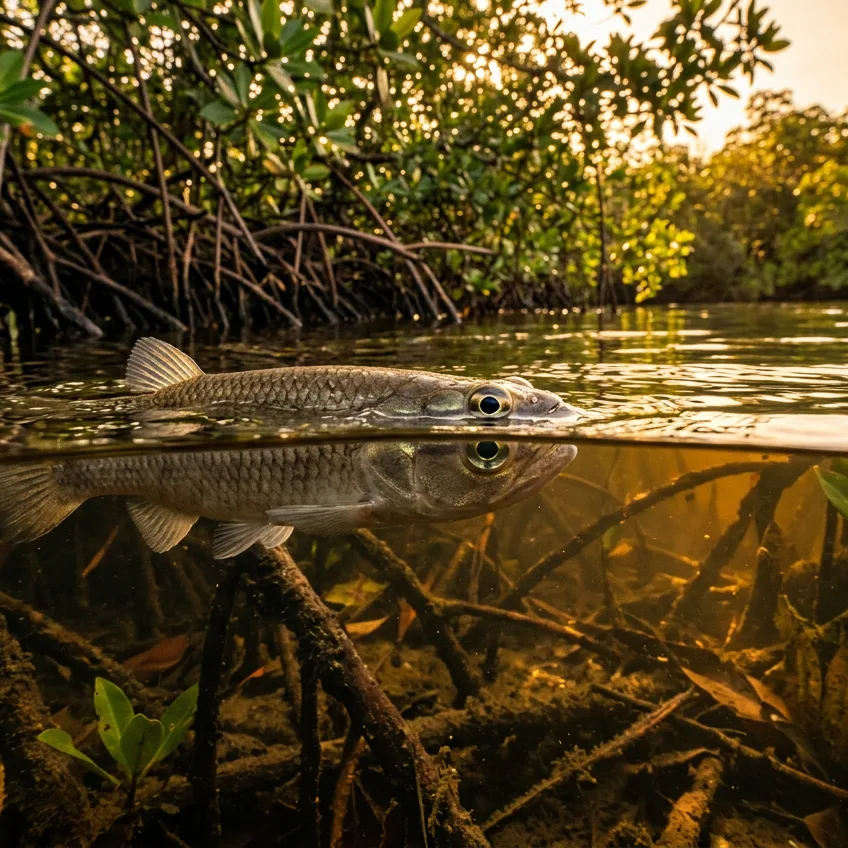
In the murky waters of mangroves and river mouths of Central and South America lives a creature with a unique evolutionary feat: Anableps anableps, popularly known as the four-eyed fish. Although anatomically it only possesses two eyeballs, each is divided horizontally by a band of opaque tissue that splits the pupil into two independent halves.
This extraordinary adaptation allows it to swim right at the surface film of the water, keeping the upper half of its eyes in the air and the lower submerged. The true marvel of this biological engineering lies in its ability to solve a dilemma of physics: light refracts very differently in air than in water. To compensate for this difference, the lens of Anableps has an asymmetrical and oval shape; the upper part is flatter to focus in the air, while the lower curvature is more pronounced to correct for aquatic refraction.
- Double alert: It can watch for birds of prey in the sky while detecting predatory fish underwater.
- Specialized retina: It features two distinct focal zones that process both images simultaneously without disorienting the brain.
- Continuous protection: To prevent the eye exposed to the wind from drying out, the fish simply dips its head intermittently for a fraction of a second.
Thanks to this 360-degree split vision, this small hunter of about 30 centimeters rules the exact boundary between two worlds, catching flying insects and small crustaceans with millimeter precision.
Source: Smithsonian Tropical Research Institute / Journal of Experimental Biology