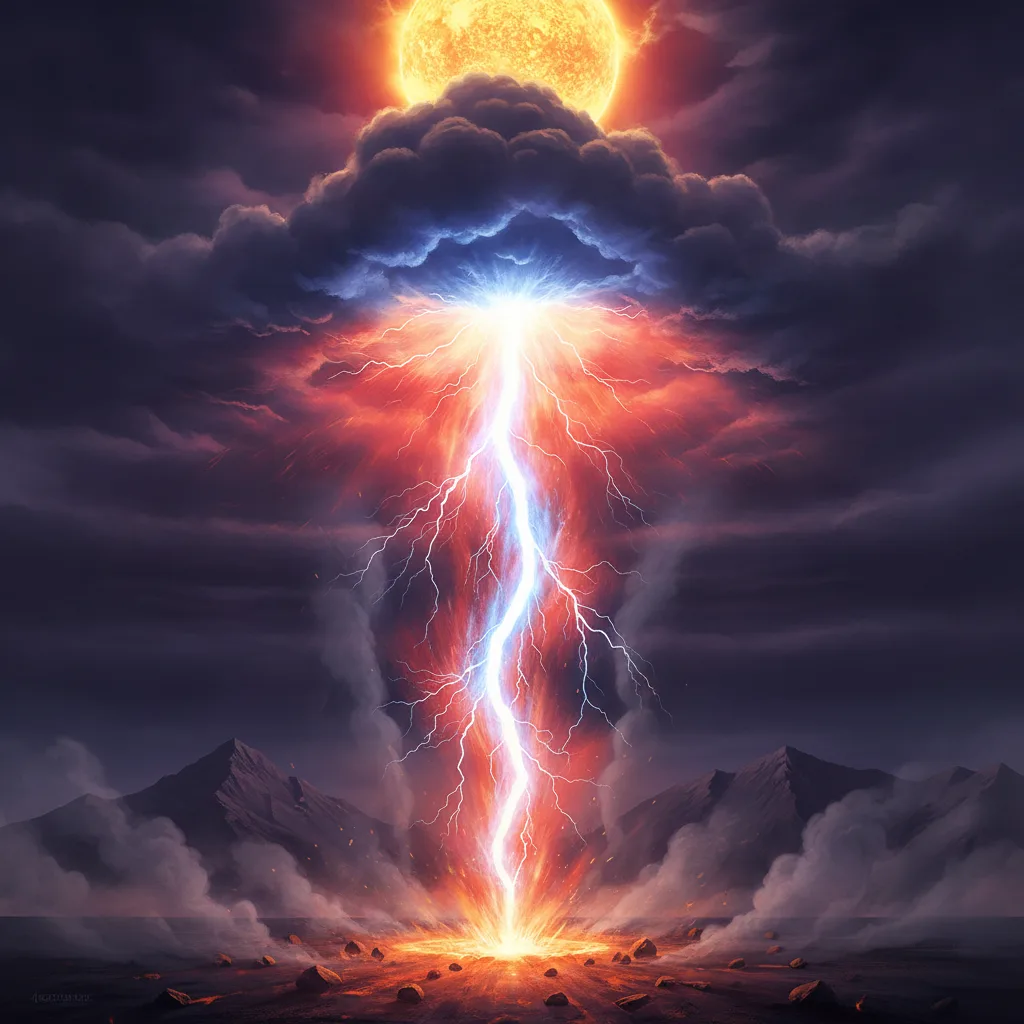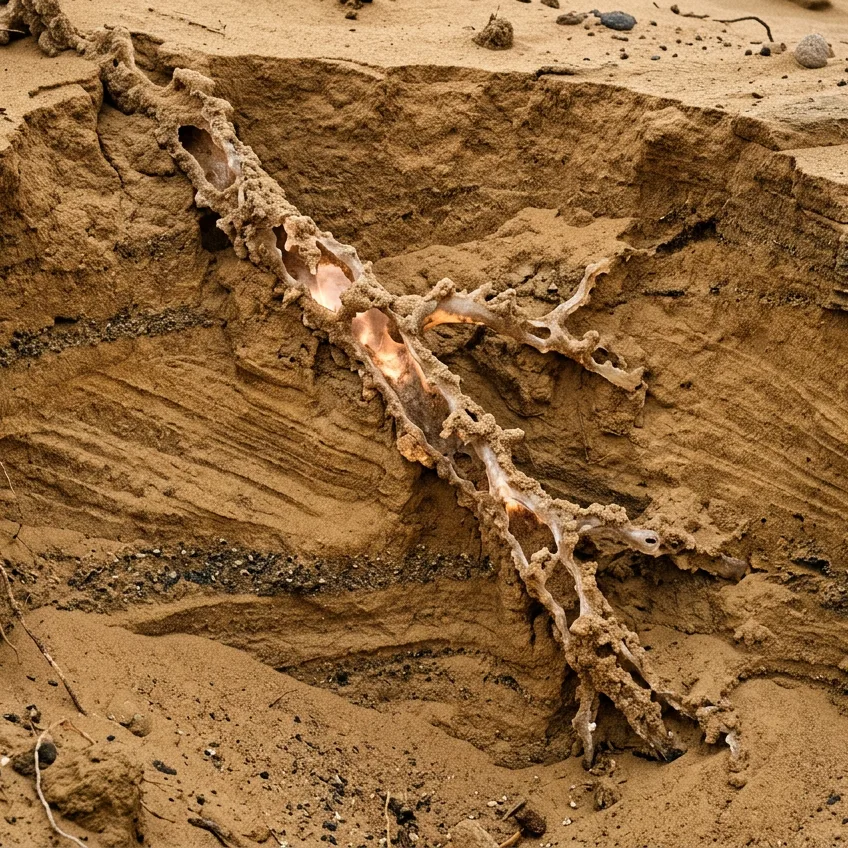
When cloud-to-ground lightning discharges its energy into a desert dune or a quartz-rich beach, it triggers one of the most violent and rapid metamorphic processes on the planet. With instantaneous temperatures that can exceed 30,000 °C—five times hotter than the visible surface of the Sun—the plasma channel does not heat the sand gradually: it melts silica in mere microseconds and vaporizes the center of the column due to the brutal shock wave.
The sudden thermal quenching caused by the surrounding ground prevents minerals from crystallizing in an orderly fashion. Instead, the quartz collapses into an amorphous natural glass phase known as lechatelierite. The resulting structure is called a fulgurite: a hollow, branching cylinder that faithfully reproduces the three-dimensional path of lightning penetrating the subsurface.
These geological formations exhibit fascinating features:
- Glassy interior and rough exterior: Its internal channel is smooth and shiny like glazed porcelain, while its outer walls retain partially melted sand grains.
- Astonishing dimensions: Although extremely fragile, continuous specimens over ten meters in length have been unearthed.
- Atmospheric time capsules: The impact seals tiny air bubbles within the glass, allowing geochemists to analyze the atmospheric composition and organic remains of storms that occurred thousands of years ago in regions that are now hyper-arid, such as the Sahara Desert.
Source: Geological Society of America (GSA) / Scientific American