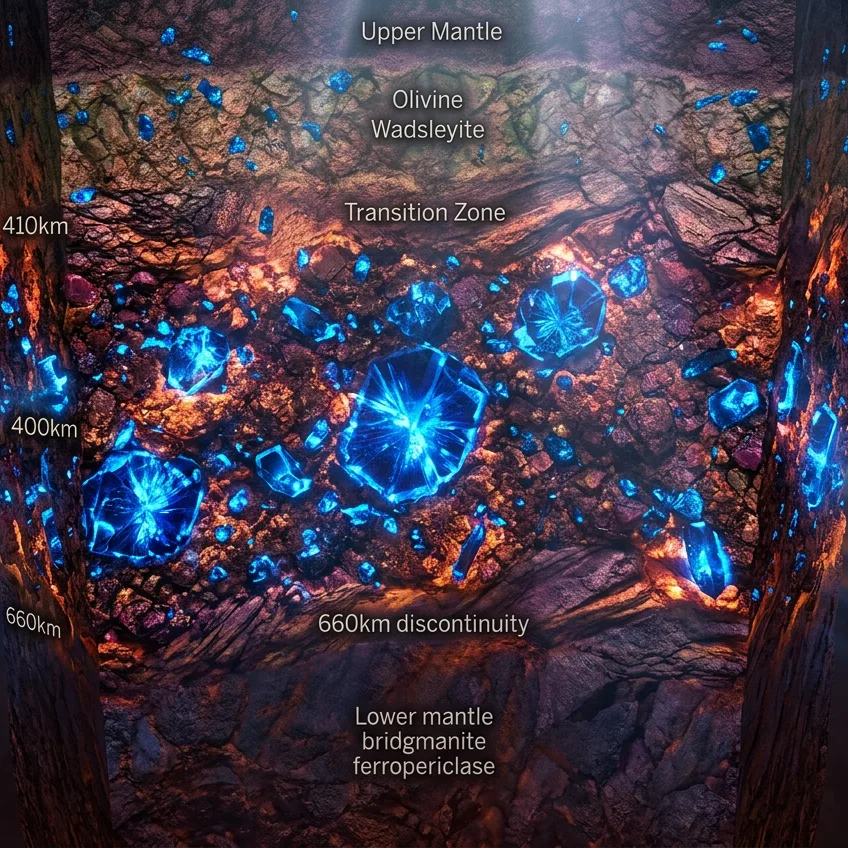
For decades, geophysicists debated whether the so-called mantle transition zone—a layer located between 410 and 660 kilometers deep—was a barren desert or a gigantic reservoir of fluids. The definitive answer came in 2014 from a team led by geochemist Graham Pearson, from the University of Alberta, after analyzing a tiny diamond measuring just three millimeters found in Juína, Brazil.
Inside that gem lay a microscopic inclusion of ringwoodite, a high-pressure phase of olivine that had never before been found intact from a terrestrial origin on the surface. When examining the crystal using infrared spectroscopy, scientists discovered an astonishing fact: 1.5% of its weight was water trapped not as free liquid, but in the form of hydroxide ions (OH⁻) integrated into its crystal lattice.
Although that percentage seems modest, the global implications are monumental:
- Titanic volume: If the entire transition zone contains similar levels of hydration, it stores as much water as all the surface oceans combined, and could even double them.
- Tectonic engine: This mineral acts as a geological sponge that softens deep rocks, facilitating mantle convection and plate tectonics.
- The origin of water: It suggests that oceans did not come exclusively from comet bombardment, but that the early Earth was already born with water trapped in its depths.
Source: Nature (Pearson et al., 2014: 'Hydrous mantle transition zone indicated by ringwoodite included within diamond')