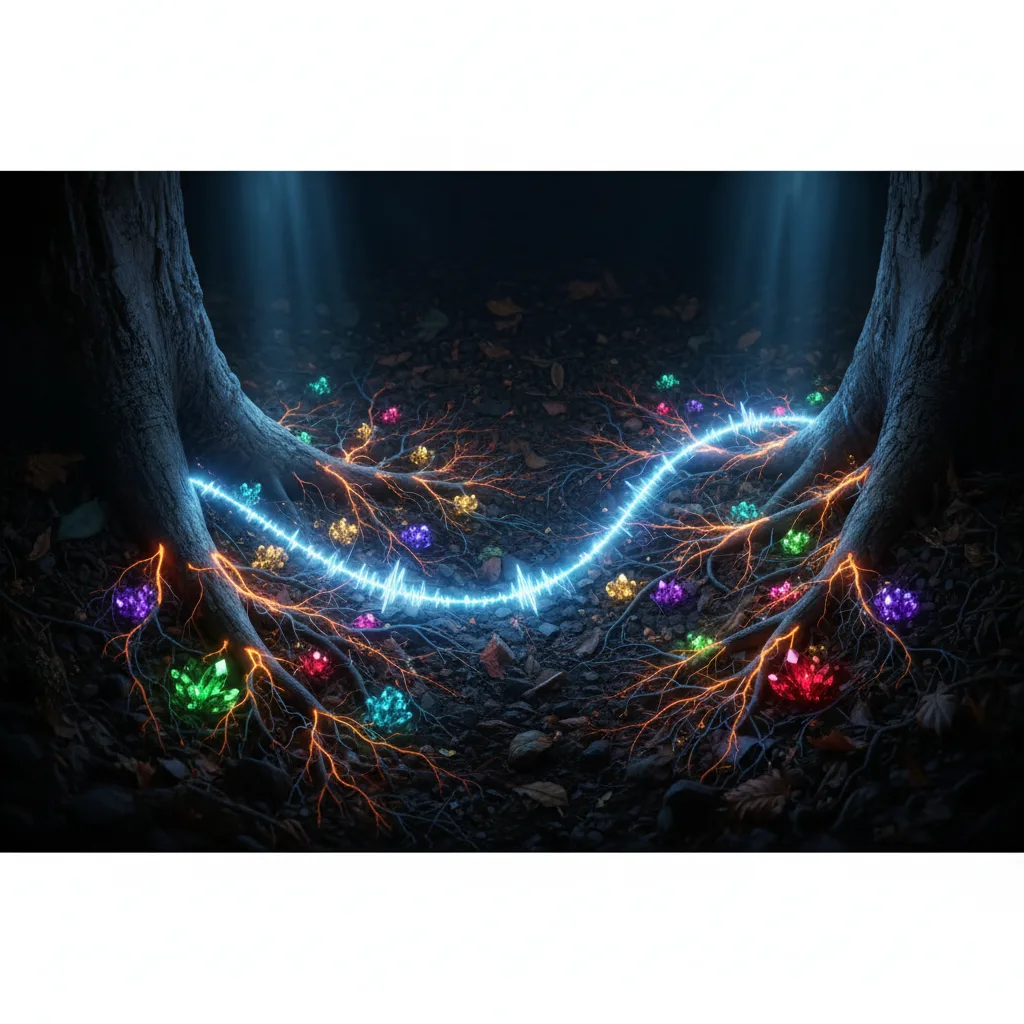
Beneath our feet, in the dark forest soil, a technological revolution is unfolding that nature perfected millions of years ago. Scientists from Aarhus University have discovered that certain soil fungi, specifically from the phylum Basidiomycota, can extract metals like copper, zinc, and manganese from the ground and transform them into conductive nanocrystals along their mycelial filaments.
This process, known as guided biomineralization, enables the mycelium to act as a network of biological wires. Through these "living circuits," the fungi do not merely transport nutrients; they also send complex electrical and chemical signals to other plants and fungi across the ecosystem. Research published in the journal Science Advances in 2023 shows that these signals can travel at speeds of up to 20 meters per second.
- Transformation: They turned metal ions into semiconducting copper sulfide nanowires.
- Communication: They transmit alerts about pests or droughts to neighboring trees.
- Storage: They use these minerals as biological batteries to store chemical energy.
This discovery is reshaping organic electronics, inspiring the design of biodegradable circuits and self-repairing electronic materials that could eliminate toxic electronic waste in the future.
Source: Zhou, S. et al. (2023). <i>Fungal mycelia convert soil minerals into semiconducting nanowires for ecosystem communication.</i> Science Advances.