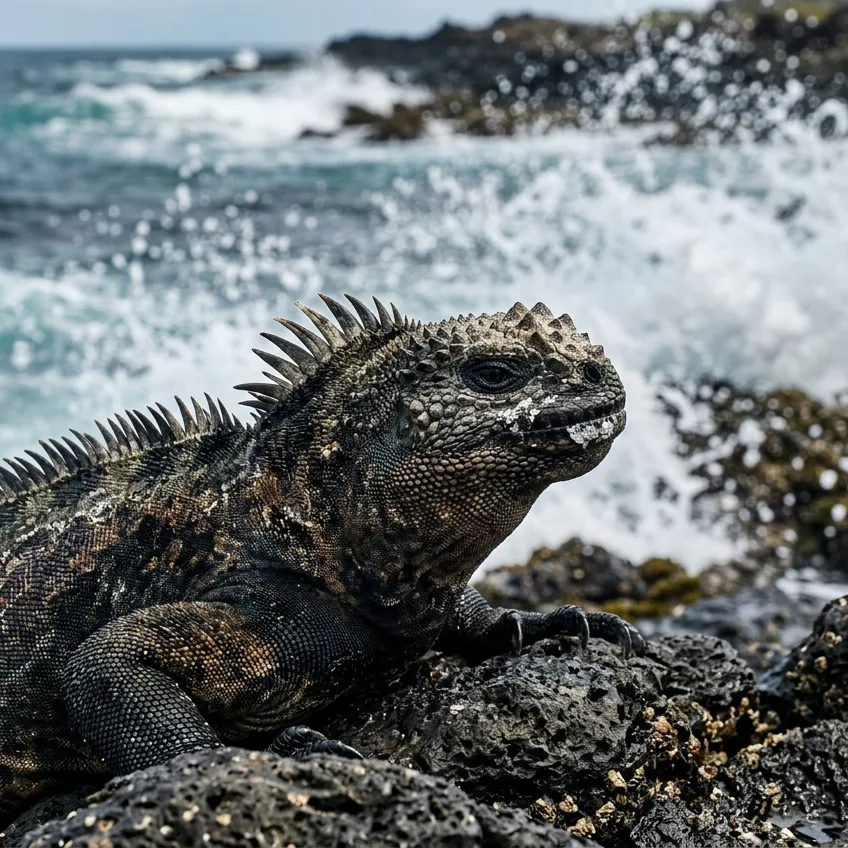
When food is scarce, almost all animals lose fat and muscle mass. However, the Galapagos marine iguana (Amblyrhynchus cristatus) resorts to a radical anatomical strategy that baffled the scientific community: it shrinks its own bony skeleton to avoid starvation.
This unusual mechanism was documented by biologists Martin Wikelski and Corinna Thom in a landmark study published in the journal Nature in the year 2000. During El Niño events, warm ocean currents displace cold upwellings and cause the massive disappearance of the red and green algae these iguanas feed on along underwater rocks.
To drastically reduce their metabolic expenditure and optimize every available calorie, adults do not just consume their soft reserves:
- Active bone reabsorption: Their bodies reabsorb connective tissue and bone matter from the spine and limbs, reducing their total body length by up to 20% (a decrease of up to nearly seven centimeters in the largest specimens).
- Reversible regeneration: When the ocean cycle returns to normal and algae proliferate once again, the bones grow back until they regain their original size.
Throughout their roughly thirty years of life, the same iguana can repeat this cycle of bone shrinkage and regrowth multiple times. It is the first documented adult vertebrate on the planet capable of dynamically reducing and reassembling its skeletal architecture without suffering permanent deformities.
Source: Nature (Wikelski & Thom, 2000: 'Marine iguanas shrink to survive El Niño')