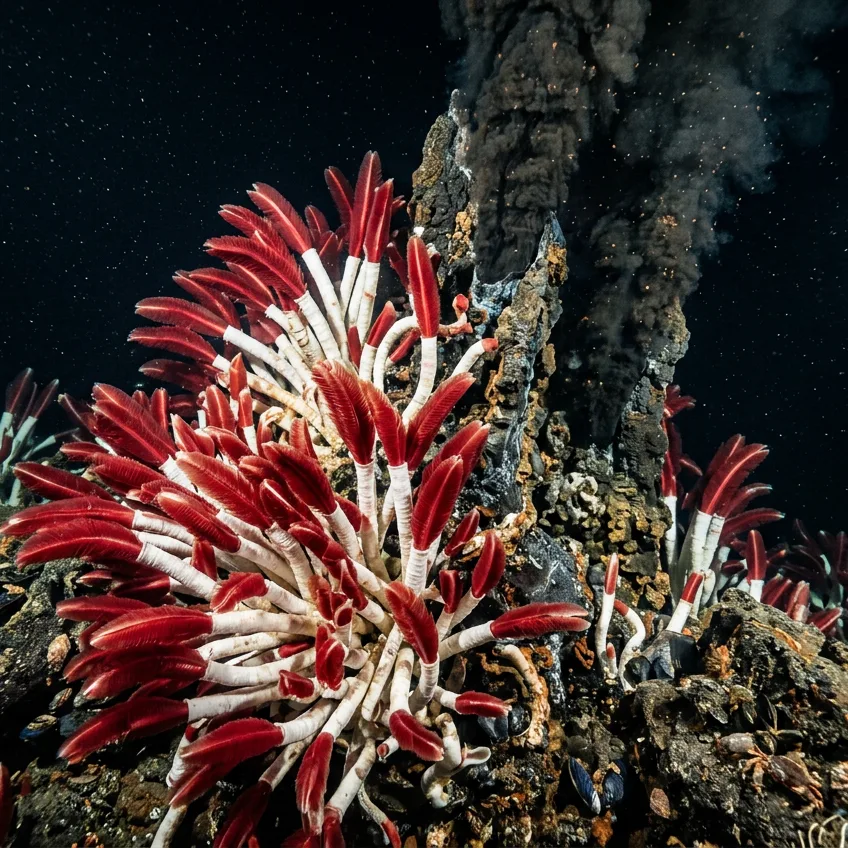
More than 2,500 meters beneath the ocean surface, around underwater volcanic vents that spew boiling water laden with lethal compounds, lives one of the most unusual organisms in the animal kingdom: the giant tube worm (Riftia pachyptila). These creatures, protected inside rigid white chitin tubes, can reach 2.4 meters in length and completely lack a mouth, gut, and anus.
Their survival defies conventional biological rules thanks to two amazing adaptations:
- The trophosome and chemosynthesis: Half of their body mass is occupied by a vascularized organ packed with symbiotic bacteria. Instead of relying on solar photosynthesis, these bacteria oxidize hydrogen sulfide (a gas lethal to almost any other animal) and transform inorganic carbon into nutrients for the worm.
- Immense hemoglobin: The bright red plume emerging from the end of the tube captures oxygen and sulfide simultaneously. To avoid suffocating or poisoning itself, Riftia possesses gigantic hemoglobin molecules, thirty times larger than human ones, with separate binding sites that stably transport both gases to its bacteria.
Discovered in 1977 on Pacific ridges during dives by the submersible Alvin, these worms also boast one of the fastest growth rates on the planet: they can build more than one meter of rigid tube in just twelve months, demonstrating that life can thrive in conditions of chemical nightmare and absolute gloom.
Source: National Oceanic and Atmospheric Administration (NOAA) / Woods Hole Oceanographic Institution (WHOI)