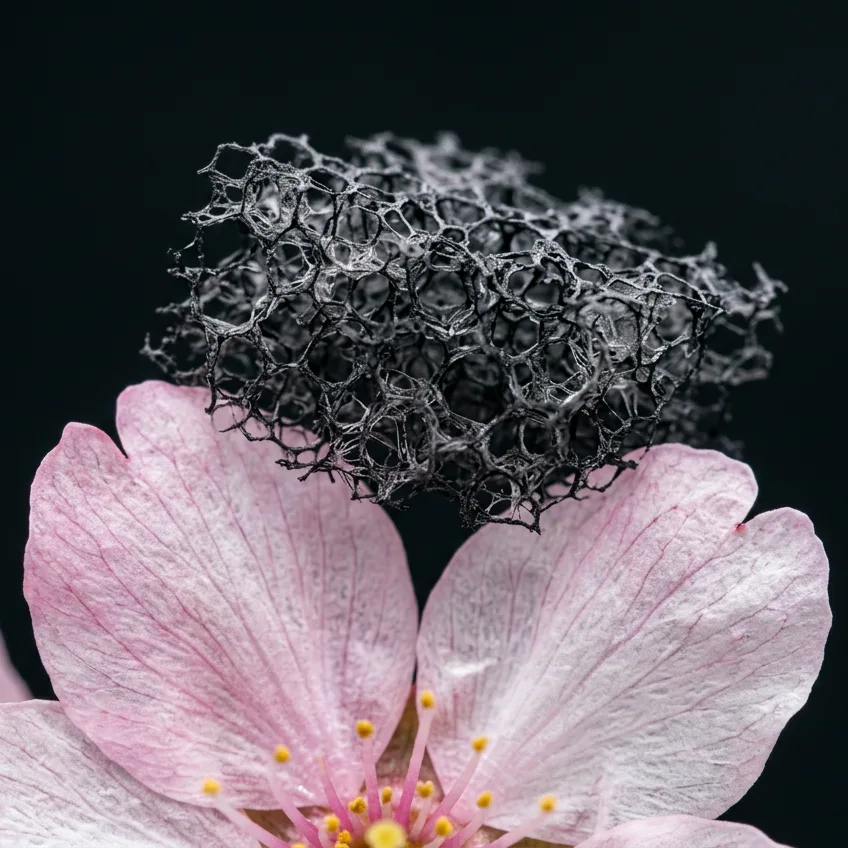
In 2013, a team of scientists from Zhejiang University (China), led by Professor Gao Chao, broke the Guinness World Record for material lightness by synthesizing graphene carbon aerogel. This compound reached an astounding density of just 0.16 milligrams per cubic centimeter, which means it is roughly six times lighter than the atmospheric air we breathe.
To demonstrate its unusual lightness, the researchers placed a cylindrical sponge of this material directly on the stamens and petals of a cherry blossom; the flower did not even bend under its weight. The key to this feat lies in its manufacturing process using freeze-drying of carbon nanotubes and single-atom-thick graphene sheets, creating a microscopic architecture where 99.9% of the total volume is trapped air.
Despite looking like an ethereal shadow, graphene aerogel has revolutionary mechanical and industrial properties:
- Hyperbolic elasticity: It can be compressed to 80% of its original size and bounce back intact to its previous shape without losing structural strength.
- Colossal absorption capacity: It can swallow up to 900 times its own weight in organic compounds such as oils and solvents in mere seconds, without absorbing a single molecule of water.
- Extreme electrical and thermal conductivity: It opens the door to ultralight batteries, supercapacitors, and space insulation for cryogenic missions.
Its development marks a turning point in materials engineering, transforming the cleanup of offshore oil spills and aerospace design.
Source: Nature Materials / Advanced Materials (Zhejiang University, 2013)