In 2018, a team from the Massachusetts Institute of Technology (MIT) led by Spanish physicist Pablo Jarillo-Herrero achieved one of the major milestones in modern physics by discovering what is known today as graphene's magic angle.
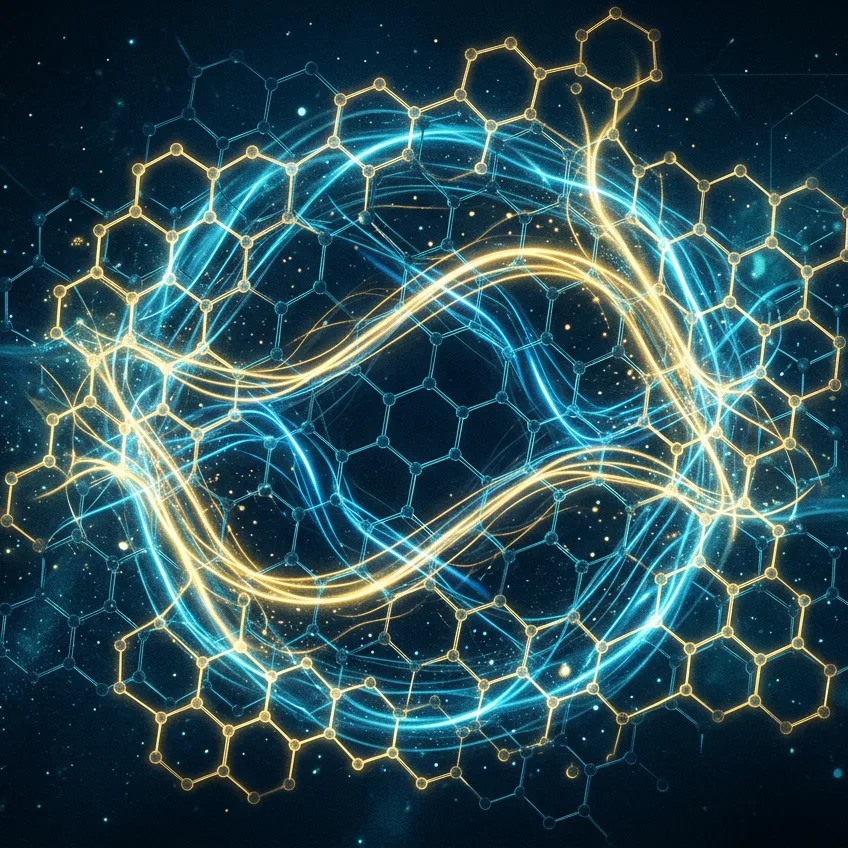
Graphene is a one-atom-thick sheet of carbon arranged in a hexagonal lattice. On its own, it conducts electricity remarkably well, but its behavior changes radically when two sheets are stacked with a slight misalignment. If the relative twist between both layers reaches exactly 1.1 degrees, an extraordinary quantum anomaly occurs:
- Electronic slowdown: Periodic interference between the two atomic lattices creates a moiré pattern that drastically reduces electron speed.
- Quantum correlation: By moving so slowly, electrostatic interactions between electrons dominate the system, forcing them to coordinate in unusual ways.
- Instant superconductivity: Just by adjusting an external electric field, the material transitions from a perfect insulator to a superconductor capable of carrying current without dissipating energy or heat.
This discovery gave rise to a new scientific discipline dubbed twistronics (from the English word twist). Before this experiment, altering the electronic properties of a crystal required chemical doping with other elements; today, rotating atomic sheets with millimetric precision is enough to create exotic states of matter at will, opening the door to future quantum computers and power grids without energy loss.
Source: Nature (2018), 'Unconventional superconductivity in magic-angle graphene superlattices' - MIT