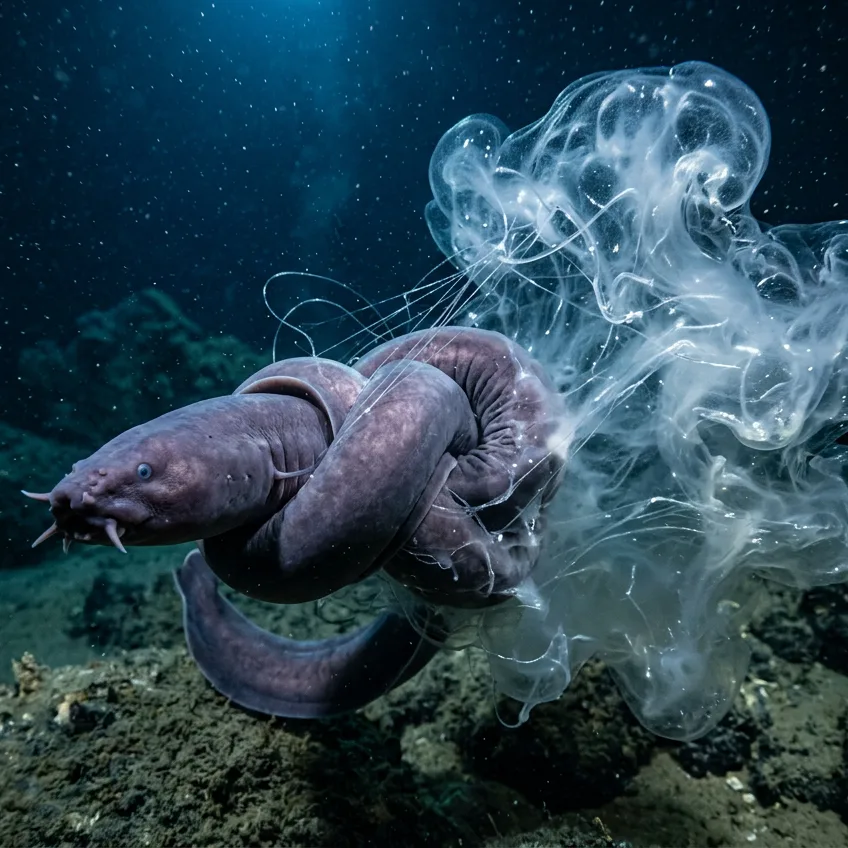
Deep on the ocean floor lives the hagfish (class Myxini), a jawless agnathan fish that has barely changed its basic anatomy in over 300 million years. Despite lacking scales, paired fins, or developed eyesight, this living fossil vertebrate possesses one of nature's most effective and surprising defense systems: a secretion that neutralizes the ocean's top predators in the blink of an eye.
When a shark or other large fish attempts to bite a hagfish, the creature stimulates roughly one hundred glandular pores that expel a tiny amount of milky fluid. In just 400 milliseconds, that fraction of a milliliter reacts with seawater and expands more than ten thousand times its original volume, instantly turning into about one liter of an elastic, suffocating hydrogel.
The key to this nearly instantaneous reaction lies in two microscopic cellular components:
- Gland thread cells: Cells that house a keratin-like thread up to fifteen centimeters long, tightly packed into a microscopic space. Upon contact with saltwater, the skein unravels at lightning speed without knotting.
- Mucin vesicles: Microscopic sacks that swell and hydrate in unison, trapping surrounding water within the dense network of protein threads.
The effect is devastating for the aggressor: the gel immediately saturates and clogs the predator's gills, threatening to suffocate it unless it releases its prey immediately. While the attacker violently gags to clear its airways, the hagfish ties itself into a knot to scrape the excess slime off its skin and escape unharmed.
Source: Journal of Experimental Biology / Current Biology (Fudge et al., hagfish biomechanics)