For more than a century, biology maintained an unquestionable principle: to be a multicellular animal, breathing oxygen was essential. However, in 2020, scientists from Tel Aviv University led by Dorothea Huchon broke this universal dogma after sequencing the genome of Henneguya salminicola, a microscopic parasite belonging to the phylum Cnidaria—the group of jellyfish and anemones—that resides in salmon muscle tissue.
The finding demonstrated an unprecedented phenomenon in modern zoology: this organism not only does not consume oxygen, but it has completely discarded its mitochondrial genome and all nuclear genes responsible for aerobic cellular respiration. Although it retains vestigial organelles derived from mitochondria, these lack internal cristae and the enzymatic machinery needed to process oxygen and generate ATP through the usual pathway.
At an evolutionary level, this parasite chose the path of maximum biological simplification:
- Massive genetic savings: By suppressing aerobic respiration, it eliminated the need to transcribe and maintain complex mitochondrial protein complexes.
- Anoxic adaptation: It thrives in the dense, virtually oxygen-depleted environments of its hosts' muscles, obtaining energy through direct anaerobic metabolism of the fish's nutrients.
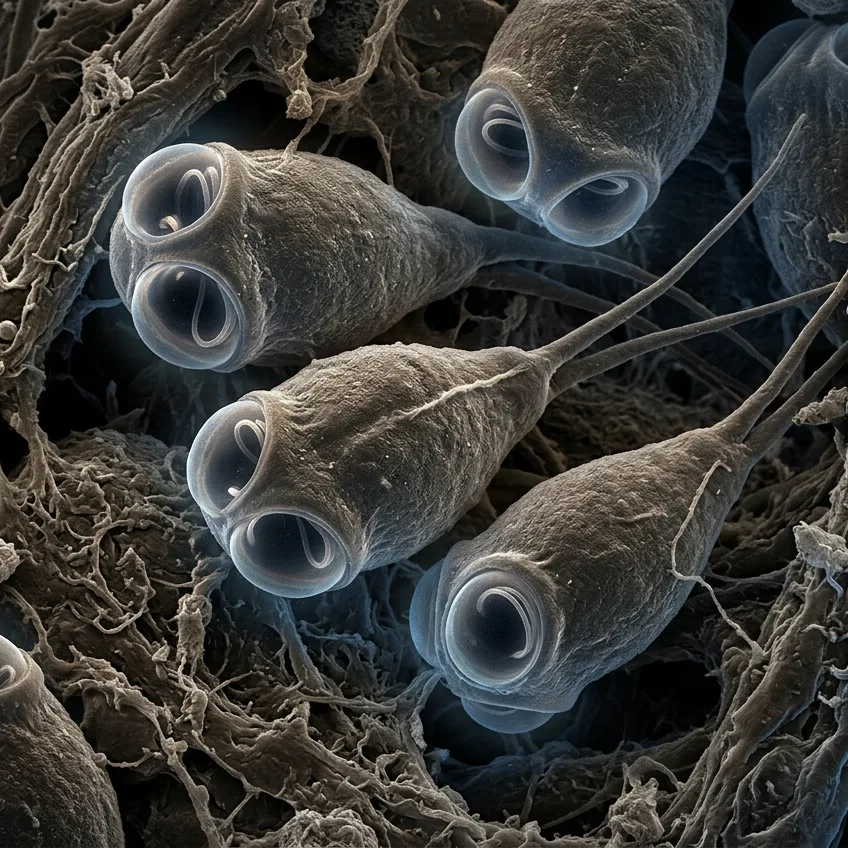
- Alien morphology: Its spores feature two polar capsules with extrudable filaments that give it an appearance almost identical to a tiny face with two bright eyes.
This astonishing parasite confirmed that evolution does not always move toward greater anatomical sophistication, but that the loss of traditional vital functions can be the most efficient evolutionary strategy.
Source: Proceedings of the National Academy of Sciences (PNAS, 2020) - Tel Aviv University