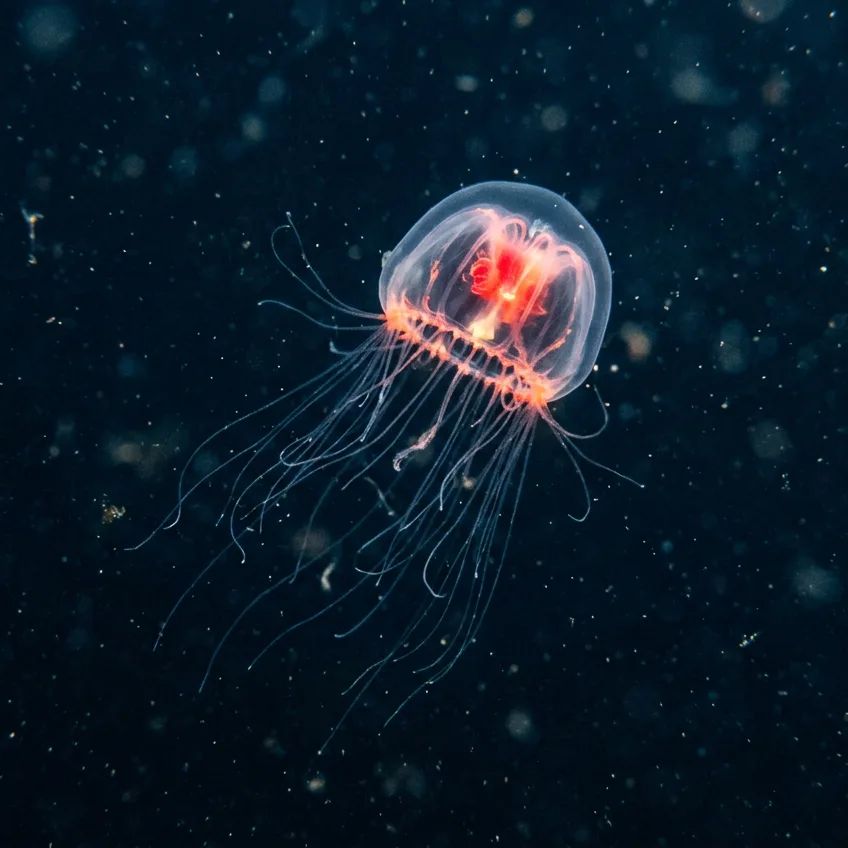
In the animal kingdom, senescence and death seemed like an inescapable biological law until science turned its lens toward the jellyfish Turritopsis dohrnii. With a diameter of barely four and a half millimeters, this tiny marine hydrozoan possesses an unmatched ability: it is biologically immortal. When it suffers from starvation, physical stress, drastic shifts in ocean salinity, or reaches advanced age, it does not perish; it flips a biochemical switch that completely reverses its life cycle.
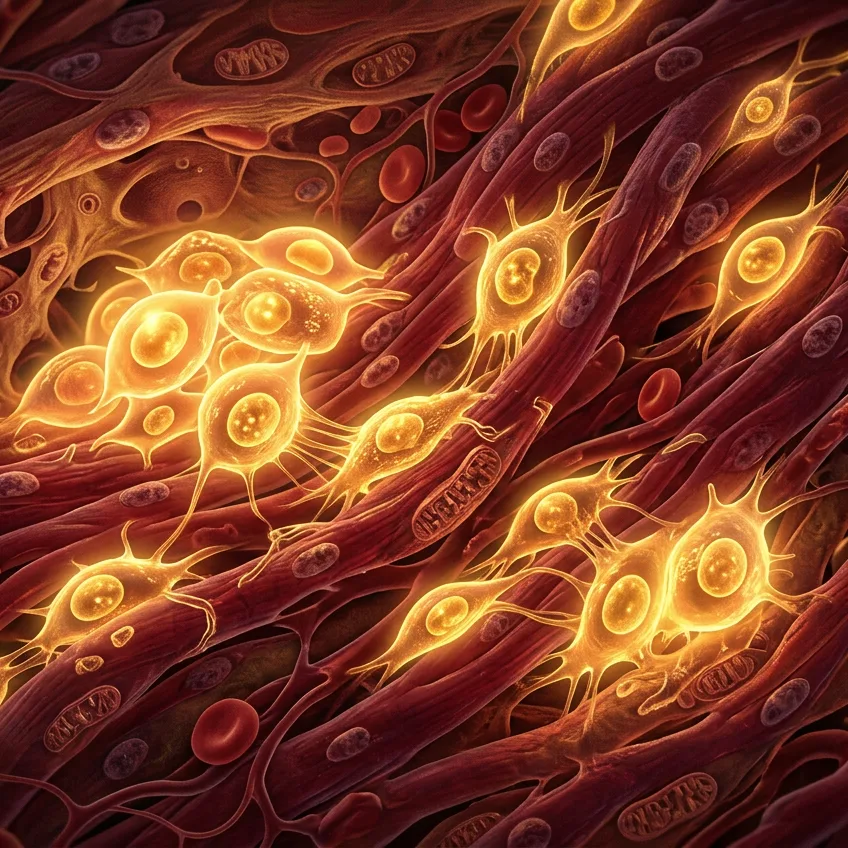
The secret behind this feat is cellular transdifferentiation, an extremely rare phenomenon in nature. While specialized cells in vertebrates (such as muscle cells or neurons) permanently lose their ability to transform into other tissues, T. dohrnii can reprogram its mature cells. The jellyfish reabsorbs its bell and tentacles, shrinking its body into a shapeless mass where the cells lose their previous identity and become undifferentiated stem cells.
From this primordial biological mass, the cells reorganize on the seabed to build a stolon from which a fully functional polyp sprouts. From that asexual colony, dozens of new adult jellyfish genetically identical to the original individual will emerge. By repeating this reversal again and again, the species cheats the biological clock, turning into a key subject of genetic study to unlock the secrets of regeneration and aging in modern medicine.
Source: Proceedings of the National Academy of Sciences (PNAS)