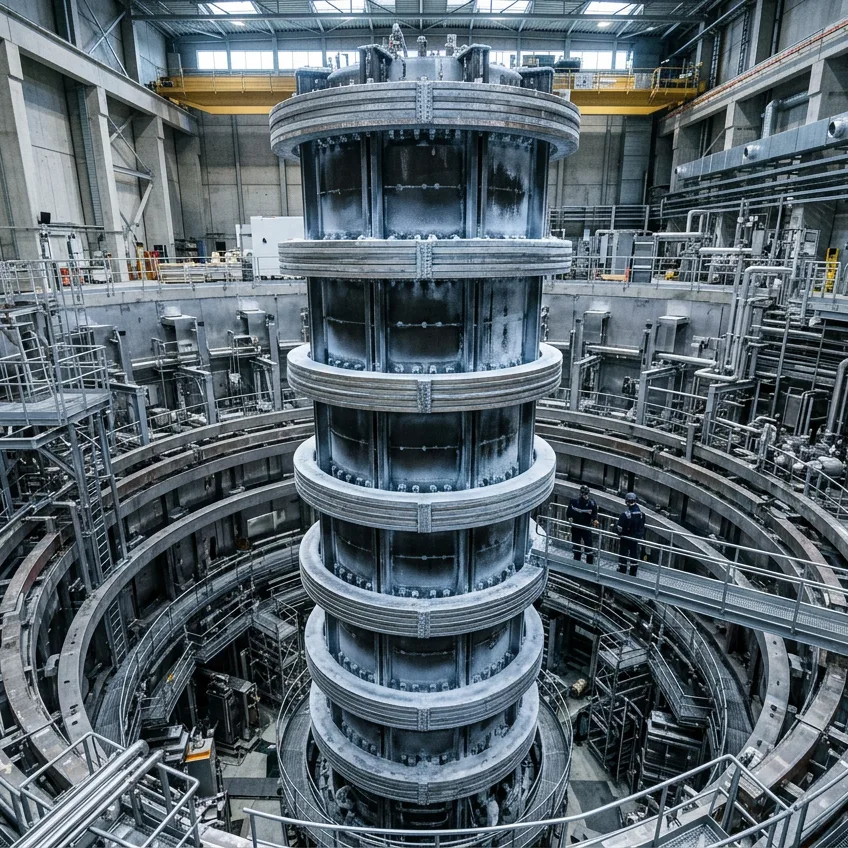
At the heart of the ITER experimental fusion reactor, located in the south of France, lies the most formidable electromagnet ever conceived by humanity: the Central Solenoid. With an imposing structure measuring 18 meters in height, 4.2 meters in diameter, and weighing nearly 1,000 metric tons, this cylinder segmented into six gigantic coils possesses a magnetic force capable of lifting a 60,000-ton aircraft carrier out of the water.
Its primary function is to induce the current that will ignite and stabilize the deuterium and tritium plasma. To achieve this, it generates a magnetic field of 13 teslas—approximately 280,000 times stronger than Earth's magnetic field—using niobium-tin superconducting conductors. These coils must be cooled with supercritical helium to just -269 °C (4 kelvin), situated merely a few meters away from a plasma inferno that will reach 150 million degrees Celsius, ten times hotter than the core of the Sun.
Such a thermal abyss is not the only extreme challenge. Operating at its maximum power, electromagnetic interactions generate colossal mechanical stresses of up to 60 meganewtons, an outward thrust twice as powerful as the combined liftoff thrust of a space shuttle. Armored to withstand these jolts for decades, the solenoid represents the highest technological summit in the race to replicate the energy of the stars on Earth.
Source: ITER Organization / General Atomics