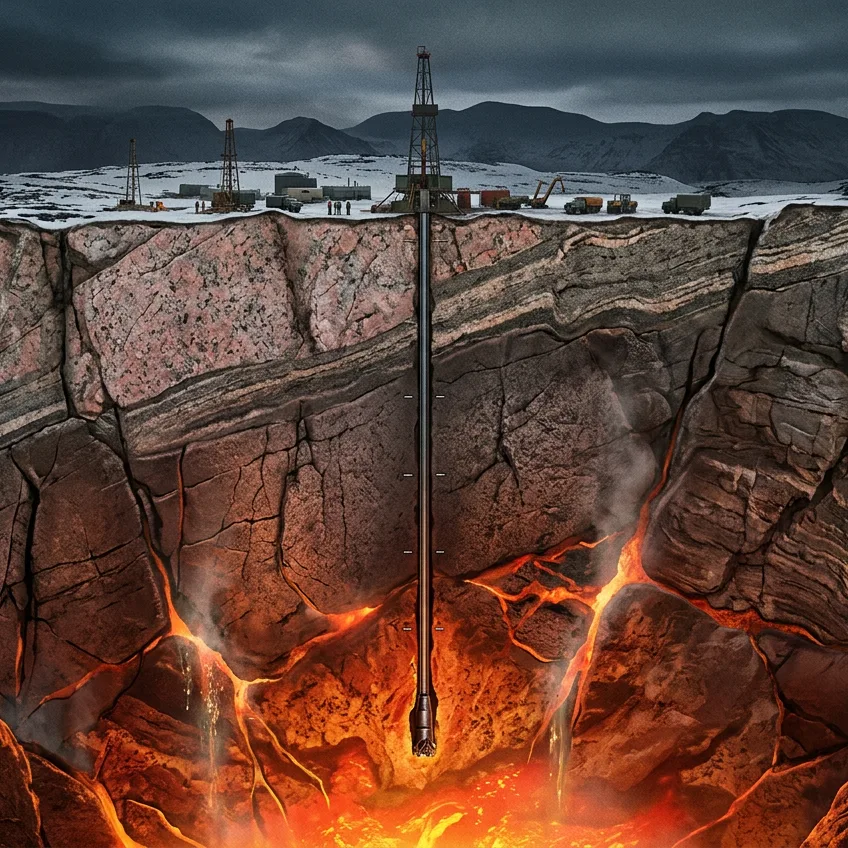
In May 1970, on the remote Russian Kola Peninsula, geologists and engineers began an unprecedented feat: drilling the continental crust as deep as technology allowed. When work stopped in 1992 after reaching 12,262 meters in depth, the SG-3 borehole established itself as the deepest artificial excavation on Earth, exposing secrets that demolished several geological dogmas.
For decades, textbooks claimed that at a depth of about 7 kilometers one would find the Conrad discontinuity, a supposed seismic boundary where continental granite gave way to a denser layer of basalt. However, the drill passed that level and found no trace of basalt: the change detected by seismographs was actually due to a metamorphic alteration of the granite itself, crushed and transformed by titanic pressures.
The site revealed even more baffling phenomena:
- Liquid water at impossible depths: Between 7 and 9 kilometers deep, the rock was neither solid nor impermeable; it was intensely fractured and soaked with mineral-rich water, formed by ions expelled from the rock crystals themselves under extreme pressures.
- Hydrogen bubbling: Mud pulled from the depths bubbled continuously with huge volumes of hydrogen gas.
- An unexpected thermal barrier: At 12 kilometers the temperature reached 180 °C, nearly double what theoretical models calculated, making the rocks so soft and plastic that the hole tended to close in on itself.
The project empirically demonstrated that the deep Earth's crust is a fractured, wet, and dynamic environment, far from the homogeneous, dry slab that geology predicted from the surface.
Source: Kozlovsky, Ye. A. (Ed.). (1987). The Superdeep Well of the Kola Peninsula. Springer-Verlag.