When we look at the night sky, stars seem to twinkle enchantingly. However, for astronomers this flickering represents a real technical nightmare known as atmospheric turbulence, a phenomenon that distorts and blurs celestial images. To bypass this obstacle without having to send every telescope into space, astrophysicists developed an ingenious method: creating their own artificial stars at the edge of space.
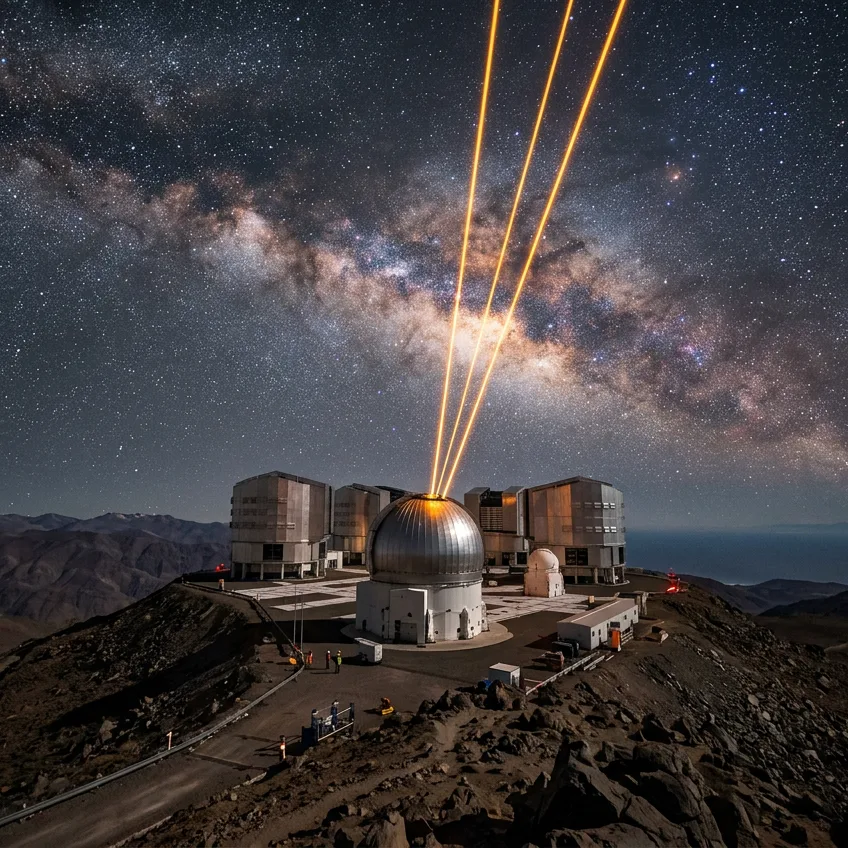
At about 90 kilometers in altitude, in Earth's mesosphere, floats a faint layer of sodium atoms deposited over eons by the disintegration of millions of micrometeorites. State-of-the-art facilities, such as the Very Large Telescope (VLT) in Chile, aim laser cannons at the zenith calibrated with extreme precision to 589 nanometers, the exact absorption wavelength of sodium. Upon receiving this energy burst, the glowing metallic particles shine like perfectly calibrated pinpoint beacons.
Through what is known as adaptive optics, the observatory analyzes the distorted pulse of that artificial star:
- Ultrafast cameras calculate how hot and cold air currents deflect incoming light in fractions of a millisecond.
- A computer transmits instant corrections to a deformable secondary mirror barely two millimeters thick.
- More than a thousand magnetic actuators alter the curvature of the glass over 1,000 times per second to counteract the atmosphere.
Thanks to this choreography of cosmic dust, lasers, and micromechanics, ground-based telescopes neutralize the air above them and capture images with a resolution that rivals space observatories such as Hubble.
Source: European Southern Observatory (ESO) - Adaptive Optics and Laser Guide Stars Technology