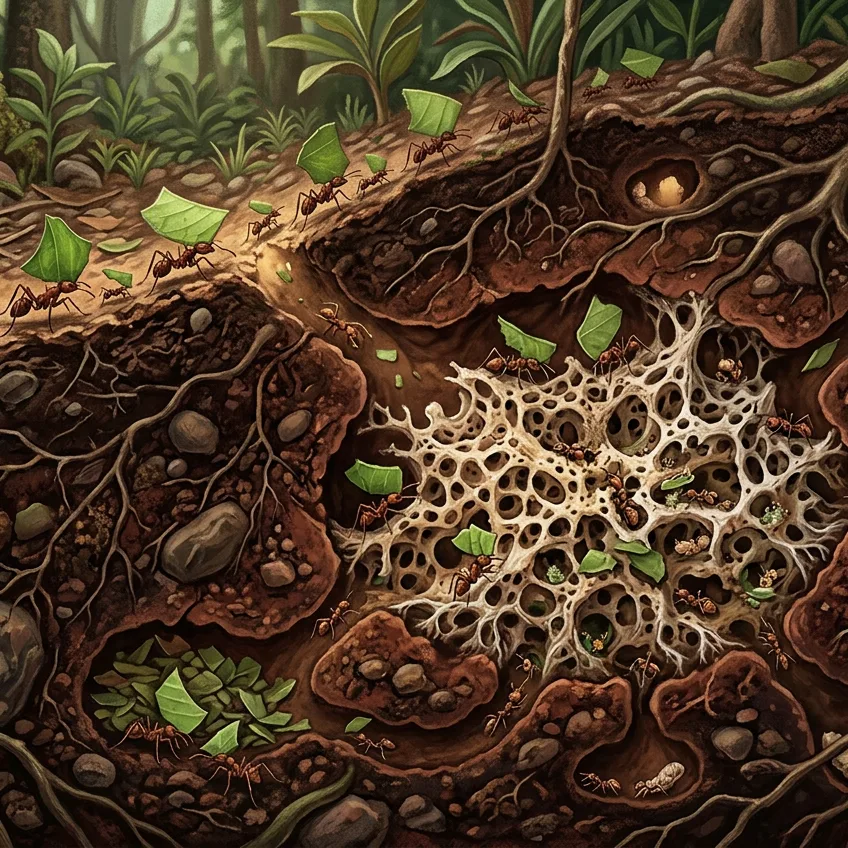
In the depths of the tropical and subtropical forests of the Americas, an industrious civilization has been practicing a form of agriculture for millions of years that surpasses many early human practices in complexity: leafcutter ants (genera Atta and Acromyrmex).
These tiny engineers do not directly eat the leaves they slice with their sharp mandibles. Instead, they meticulously carry these plant fragments to their vast underground nests. There, the leaves are chewed into a pulp and used as a substrate to cultivate a specific fungus, Leucoagaricus gongylophorus. This fungus is their sole food source and forms a perfect symbiosis: the ants feed and protect it, and the fungus produces "gongylidia," nutrient-rich structures that the ants harvest.
The organization of these colonies is astonishing, featuring a strict division of labor. The largest workers cut and transport the leaves, while smaller ones process the material and tend to the fungal gardens. There are even "minimas" dedicated to hygiene, clearing away waste and competing fungi. Some species have developed the ability to culture antibiotic-producing bacteria, protecting their crops from fungal pests.
Their nests can reach monumental sizes, with tunnels and chambers extending tens of meters underground, housing millions of individuals. This intricate network includes ventilation systems and specialized chambers for gardens and waste disposal. Leafcutter ants are living proof of nature's incredible collective intelligence and adaptation, showing that agriculture is not an invention exclusive to our species.
Source: Hölldobler, B., & Wilson, E. O. (1990). The Ants. Harvard University Press. / Nature Communications, Science.