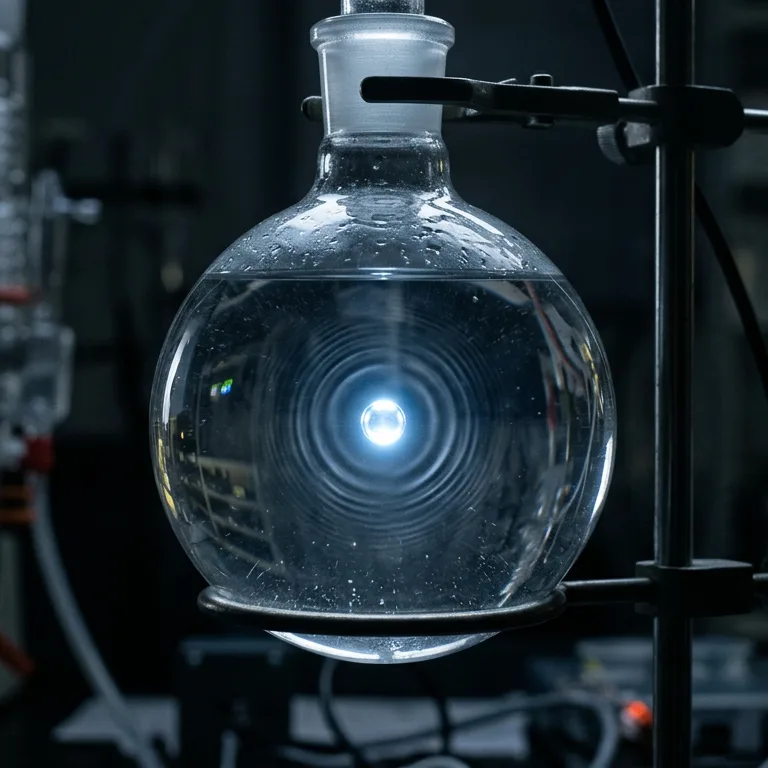
In the cosmic vacuum, light represents the universe's absolute speed limit: it travels relentlessly at 299,792,458 meters per second. Although it slows down slightly due to refraction when passing through dense substances like water or diamond, it continues to move at hundreds of thousands of kilometers per second. However, in 1999, Danish physicist Lene Vestergaard Hau and her team at Harvard University accomplished an unusual feat: they forced a pulse of light to travel at just 17 meters per second (about 61 km/h), the speed of an amateur cyclist.
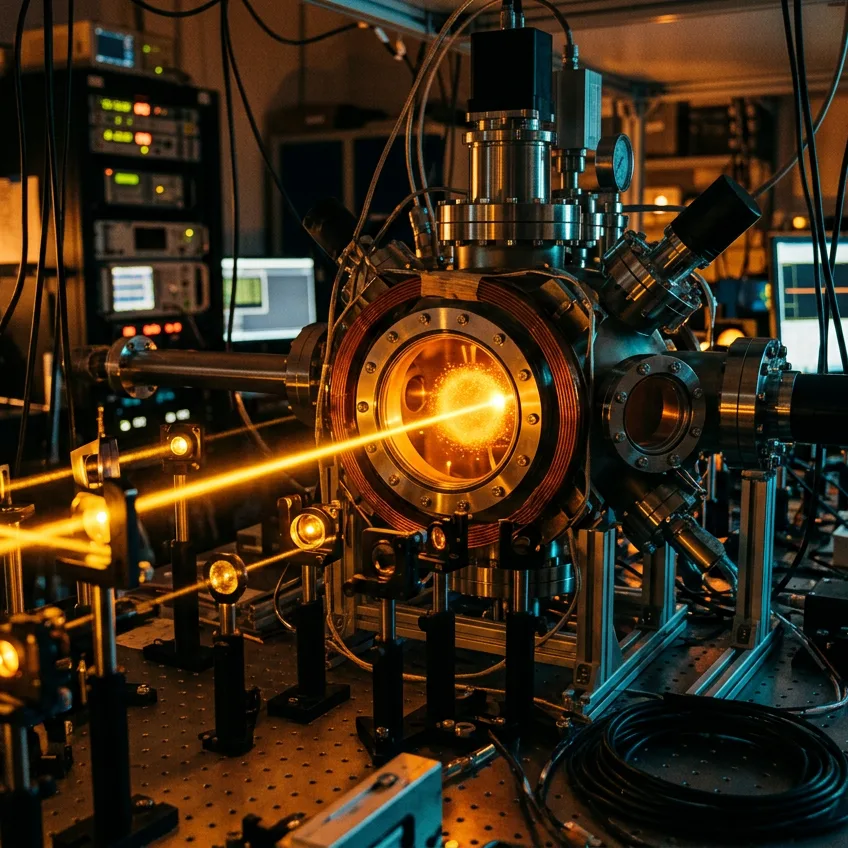
To achieve this, the scientists turned to an exotic state of matter predicted decades earlier: the Bose-Einstein condensate. They cooled a cloud of sodium atoms using magnetic traps and lasers down to near absolute zero, just nanokelvins away from −273.15 °C. At that extreme temperature, the atoms lose their individuality and collapse into a single collective quantum entity.
The mechanism behind this feat relied on two key phenomena:
- Electromagnetically induced transparency: They illuminated the atomic cloud with a control laser that altered quantum energy levels, making transparent a gas that would normally be opaque and refractory.
- Pulse compression: By introducing a probe light pulse, the photons interacted with the cloud in such a way that the radiation transferred its energy to atomic oscillations, drastically reducing its group velocity without losing information.
Shortly after, in 2001, Hau demonstrated that it was possible to stop light completely, extinguishing it temporarily inside the cloud and recreating it intact milliseconds later—a pioneering technology that today underpins the development of memories for quantum computing.
Source: Nature (Hau, L. V. et al., 1999: 'Light speed reduction to 17 metres per second in an ultracold atomic gas')