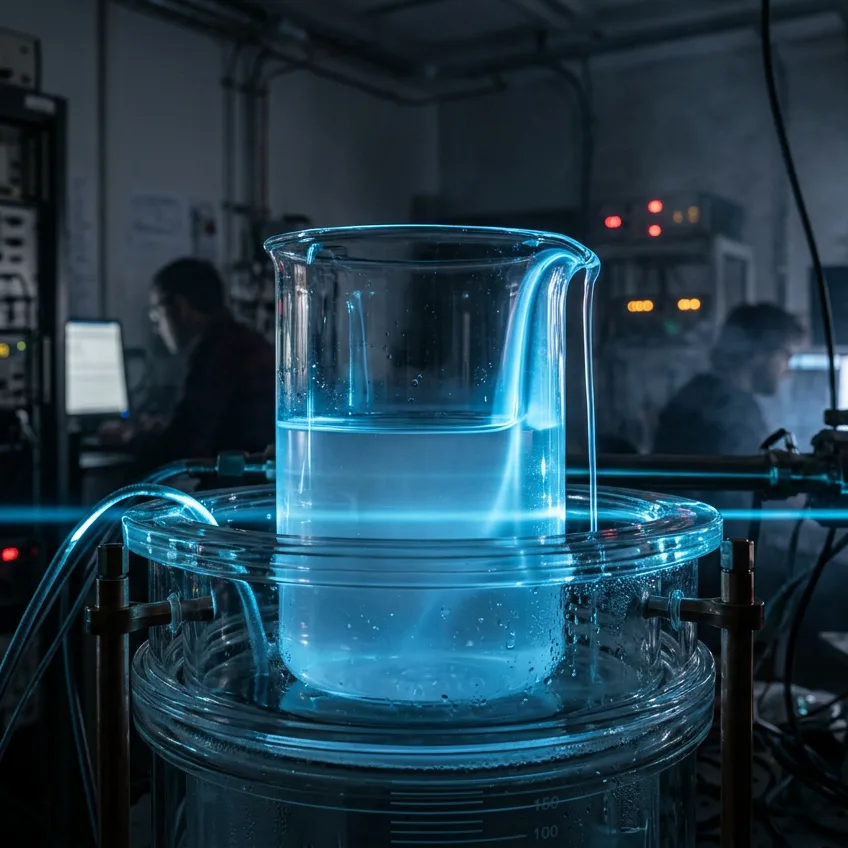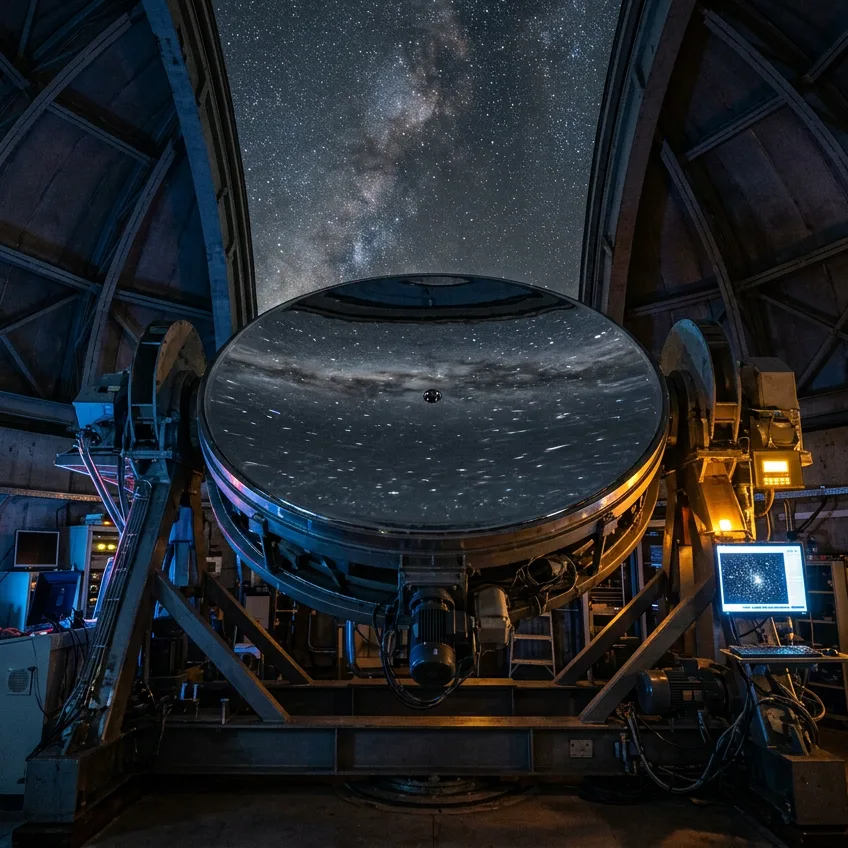
Manufacturing the primary mirror of a giant telescope is one of the slowest and most expensive tasks in modern engineering: it requires melting tons of special glass and meticulously polishing it for years to achieve nanometer-scale precision. However, an alternative technology is as ingenious as it is surprising: replacing the rigid block with a thin layer of rotating liquid mercury.
The physical principle behind these instruments, such as the International Liquid Mirror Telescope (ILMT) installed at an altitude of 2,450 meters in the Indian Himalayas, relies on the balance between two fundamental forces:
- Gravity: pulls the fluid vertically toward the center of the Earth.
- Centrifugal inertia: pushes the liquid toward the edge of the circular container as it rotates.
When a dish of mercury rotates at a rigorously constant speed (just about eight revolutions per minute), the surface of the metal naturally and spontaneously adopts the shape of a perfect paraboloid. Thanks to the extraordinary reflectivity of mercury, a collecting mirror four meters in diameter with minuscule microscopic roughness is obtained, achieved in minutes and for barely five percent of the budget of a conventional glass mirror.
Although it has the limitation of pointing only toward the zenith due to gravity, this liquid colossus scans a continuous strip of the deep sky every night, enabling the detection of supernovae, asteroids, and distant galaxies with astonishing resolution.
Source: Nature Astronomy / Devasthal Observatory (ARIES)