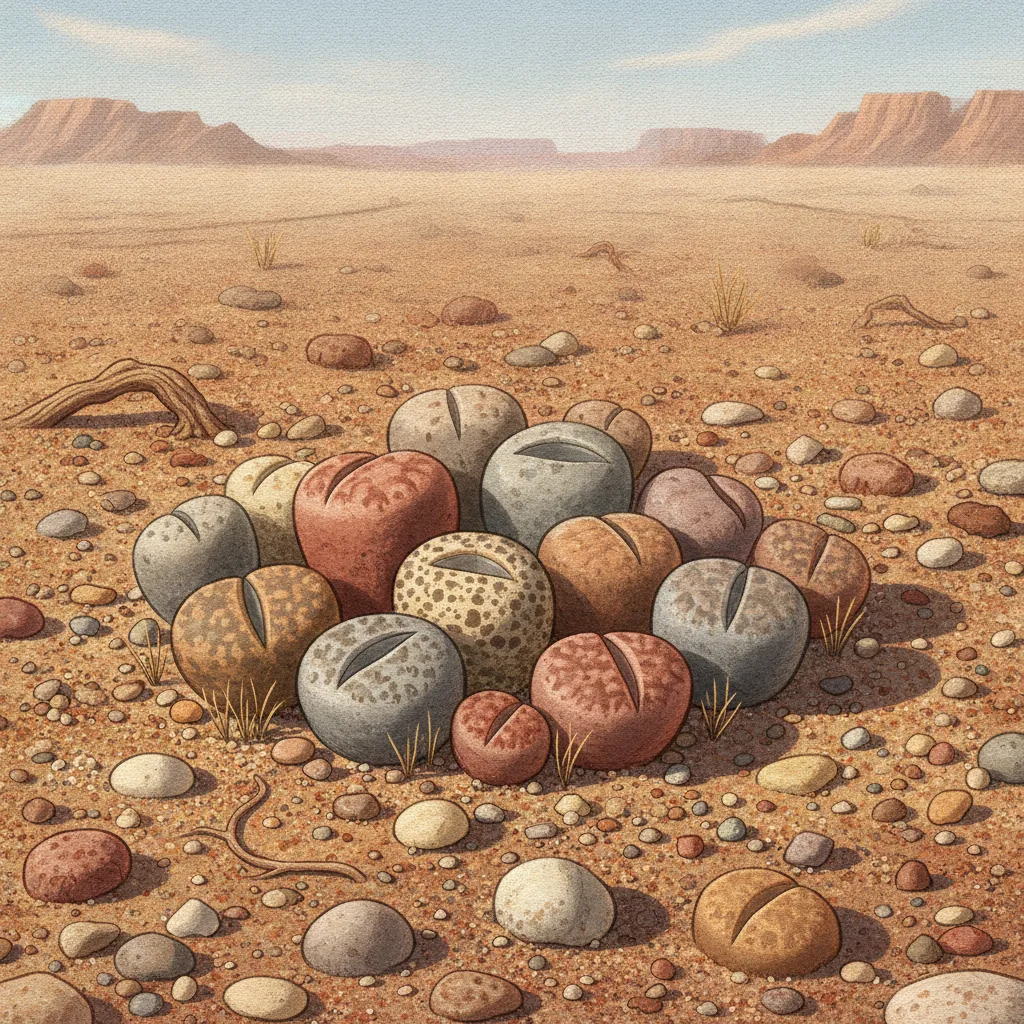
In the arid and challenging landscapes of South Africa and Namibia, there is a fascinating group of plants that have perfected the art of camouflage to an almost unbelievable degree: Lithops, popularly known as 'living stones'. These succulents do not just resemble the rocks and pebbles of their surroundings, but blend in so seamlessly that they are practically indistinguishable to the untrained eye.
Their mimicry strategy is a master adaptation against herbivores seeking to feed on them in an ecosystem where food is scarce. Most of the plant remains buried beneath the sand, leaving only the top surface exposed, which often displays patterns and colors identical to surrounding stones. Some even have translucent 'windows' on their surface, allowing sunlight to reach the subterranean photosynthetic cells—an ingenious way to capture solar energy while staying hidden.
Lithops are a testament to nature's resilience, able to survive extreme temperatures with very little water, storing it in their fleshy leaves. Despite their stony and modest appearance, they surprise with beautiful solitary flowers, usually yellow or white, that emerge between their 'lobes' in autumn. Their existence reminds us that even in the most hostile environments, life finds spectacular and surprising ways to thrive.
Source: National Geographic, Kew Royal Botanic Gardens, Botanical Society of South Africa



