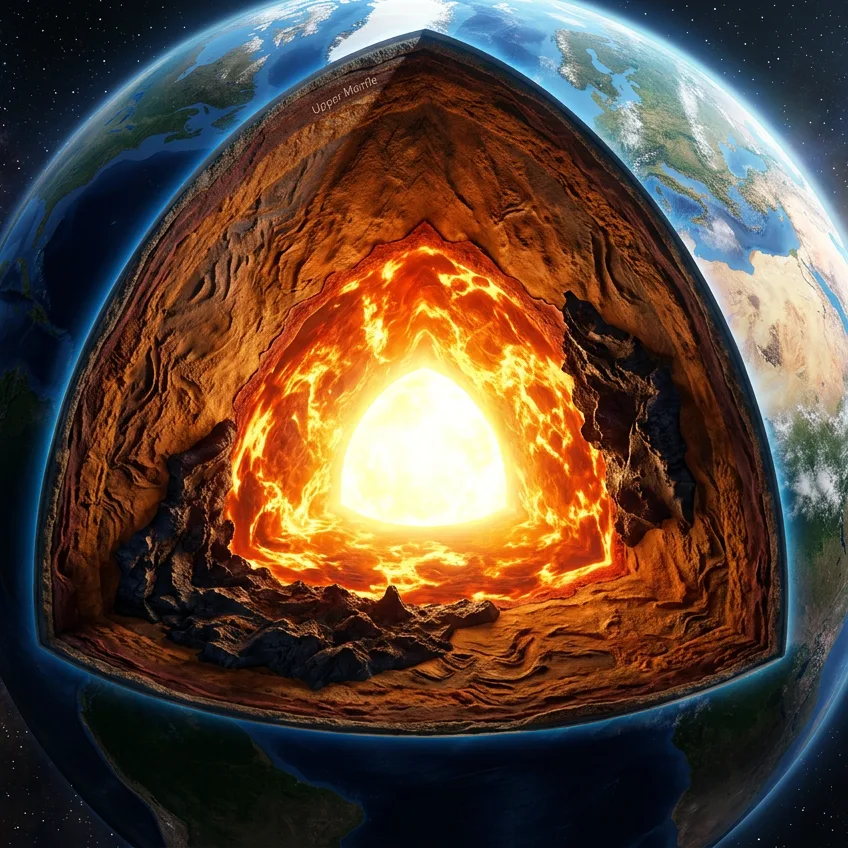
Nearly 2,900 kilometers below Earth's surface, resting directly on the blazing liquid iron outer core, lie two of the most mysterious structures in planetary geophysics: the Large Low-Shear-Velocity Provinces (known in geology as LLSVPs). One of these colossal masses extends deep beneath the African continent and the other beneath the Pacific Ocean.
These two formations are not simple terrain irregularities: they span thousands of kilometers across and rise up to one hundred times higher than Mount Everest. Together, they account for nearly 8% of the total volume of Earth's mantle and hold twice the mass of the entire Moon. They were detected using seismic tomography, a technique analogous to a global medical ultrasound: when seismic waves generated by powerful earthquakes pass through these zones, they slow down drastically, revealing that they are composed of material much hotter and between 2% and 3.5% denser than the surrounding mantle.
For decades, their origin was a complete geological enigma. However, research published in the journal Nature has provided an astonishing answer: they may be the fossil remnants of Theia, the Mars-sized protoplanet that struck the early Earth 4,500 million years ago. Following the catastrophic collision that ejected the material that formed the Moon, the densest, iron-rich fragments of Theia's mantle did not fully mix, instead sinking to the base of our planet, where they have remained isolated and nearly intact since the dawn of the solar system.
Source: Nature (Yuan et al., 2023 - 'Moon-forming impactor Theia as a source of Earth’s basal mantle anomalies')