For more than a century, an unshakable principle of biology held that no multicellular animal (metazoan) could complete its entire life cycle in the total absence of oxygen. However, in 2010, a scientific team led by biologist Roberto Danovaro overturned this biological certainty in the depths of the Mediterranean Sea, more than 3,500 meters beneath the surface.
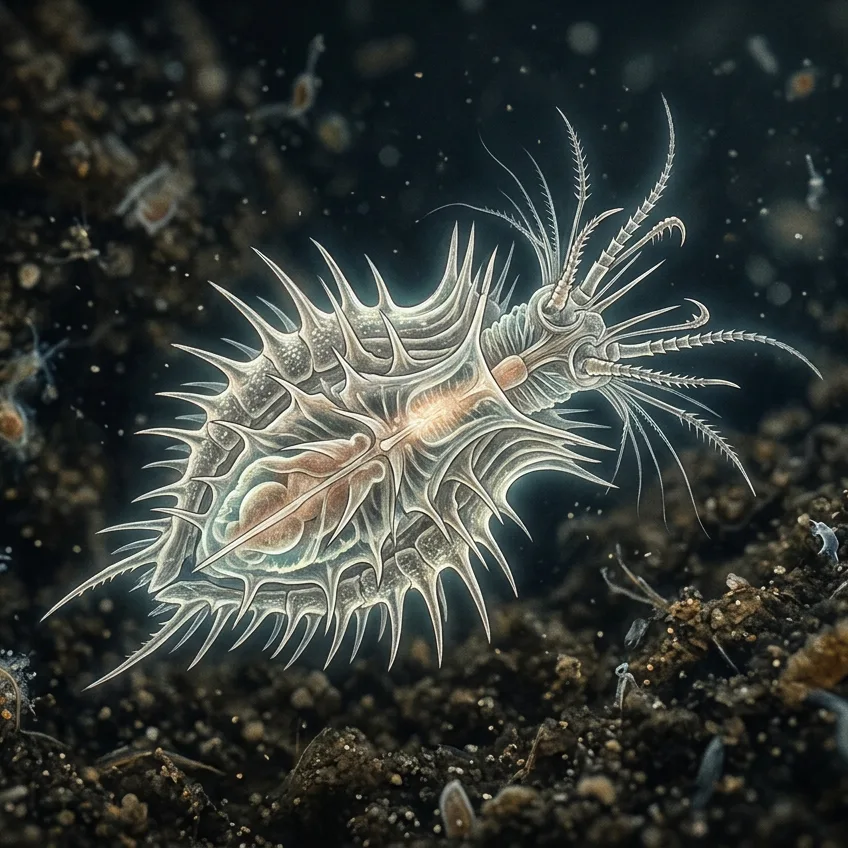
In the hypersaline and anoxic sediments of the L'Atalante basin, a toxic environment saturated with hydrogen sulfide where light and oxygen never reach, researchers discovered 3 microscopic species of the phylum Loricifera (among them Spinoloricus cinziae). These creatures, less than 1 millimeter in length, were not just passing through or in a state of dormancy: they spent their entire lives, molted their cuticle, and actively reproduced in the strictest anoxia.
Ultrastructural analysis revealed an unprecedented evolutionary adaptation in the animal kingdom:
- Total absence of mitochondria: they lack the typical cellular factories that use oxygen to produce metabolic energy (ATP).
- Use of hydrogenosomes: instead, they harbor modified organelles very similar to the hydrogenosomes of certain single-celled protozoa, capable of synthesizing energy through anaerobic pathways in close symbiosis with intracellular bacteria.
The discovery of these loriciferans rewrote the limits of modern zoology and showed that complex animal architecture does not strictly depend on oxygen, a fundamental finding that transformed astrobiology and the search for life in extraterrestrial oceans such as those of Europa or Enceladus.
Source: BMC Biology (Danovaro et al., 2010: 'The first metazoa living in permanently anoxic conditions')