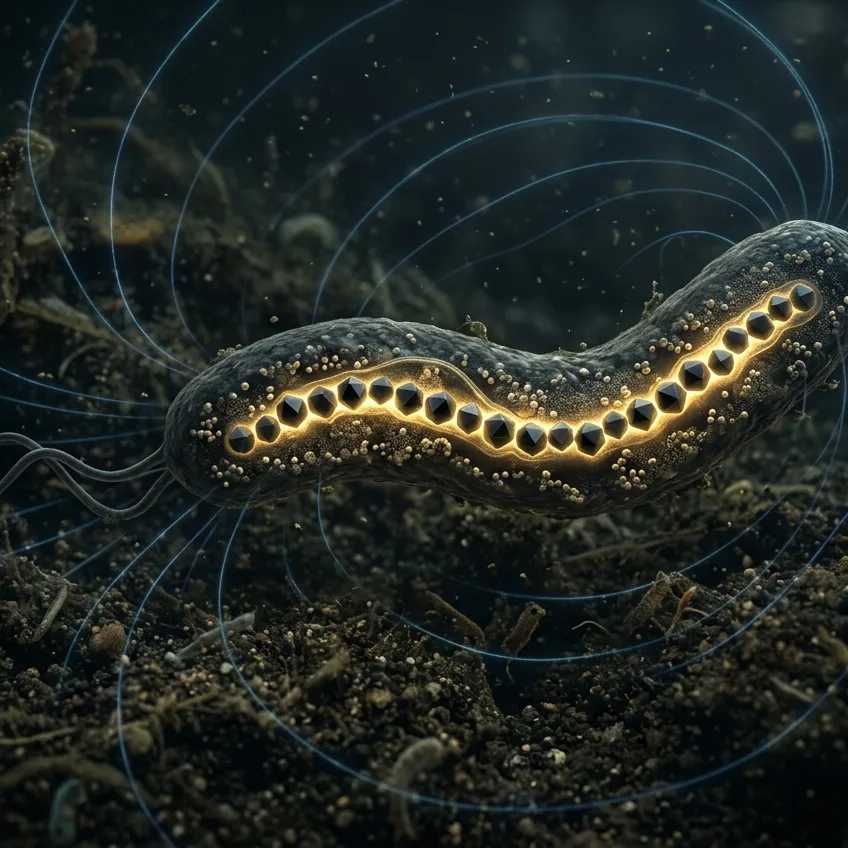
In the deep mud of lakes and oceans live microorganisms equipped with a biological compass of astonishing precision: magnetotactic bacteria. Formally identified by microbiologist Richard Blakemore in 1975, these single-celled creatures have the unusual ability to synthesize ordered chains of magnetite or greigite nanocrystals inside themselves, iron minerals wrapped in lipid membranes known as magnetosomes.
Aligned in a perfect row, these crystals act identically to the needle of a nautical compass. The magnetism requires no conscious effort: Earth's magnetic field exerts a physical torque that passively aligns the entire bacterial body. However, these microbes do not use their compass to migrate thousands of kilometers, but rather to solve a serious physics problem at the microscopic scale: the chaos of Brownian motion.
For a bacterium searching for the right depth with the ideal amount of oxygen, wandering aimlessly in three dimensions represents a lethal waste of energy. Because Earth's magnetic field lines naturally slant toward the ground across most of the planet, magnetotaxis turns an impossible three-dimensional search into a vertical, one-directional lane. Thus, by swimming forward or backward along this invisible thread, they reach their ideal microenvironment in a matter of seconds.
Source: Nature Reviews Microbiology (Frankel & Bazylinski, 'Magnetotactic Bacteria and Magnetosomes')