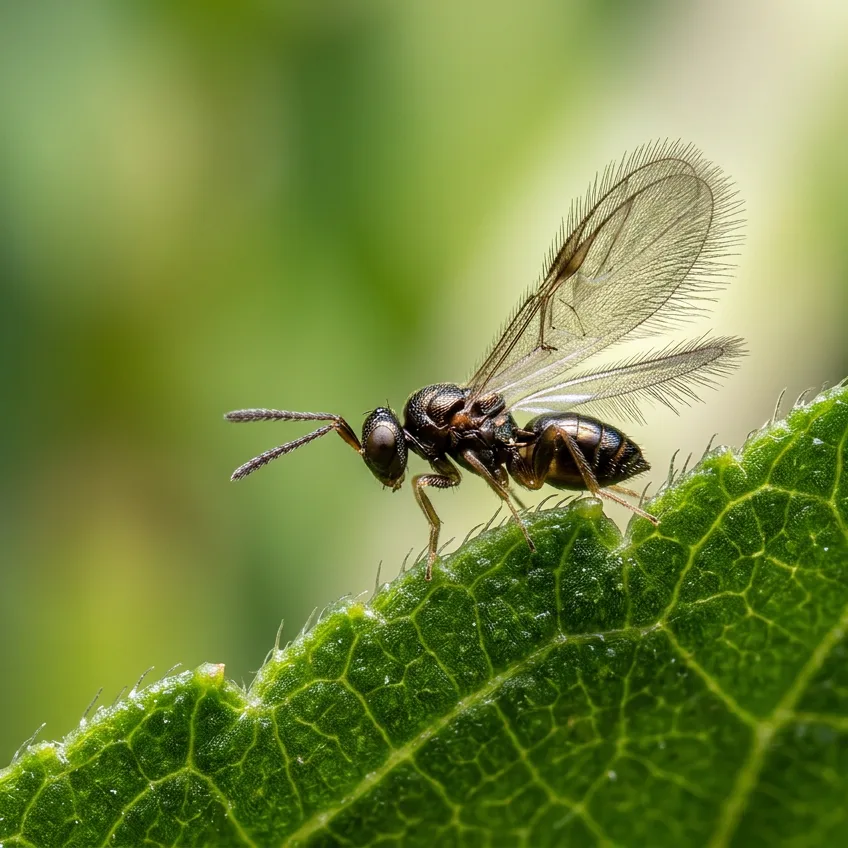
In the biological world, there is an insurmountable theoretical barrier imposed by cell size: to house a complex brain composed of thousands of neurons, an animal requires a body with a minimum volume. However, the tiny parasitoid wasp Megaphragma mymaripenne, measuring a negligible 200 micrometers (0.2 mm) and smaller than many single-celled protozoa such as the paramecium, found an unprecedented evolutionary solution in the animal kingdom.
In 2012, entomologist Alexey Polilov discovered an astonishing anomaly while studying its internal anatomy using electron microscopy: unlike any other known animal on Earth, the adult nervous system of this wasp is composed of 95% anucleate neurons—that is, brain cells devoid of a nucleus.
- Extreme metamorphosis: During its pupal stage, the wasp develops a standard brain with about 7,400 normal nucleated neurons.
- Cellular purge: Just before emerging as an adult, nearly 7,000 neurons lyse and destroy their own nuclei to cut their cellular volume in half.
- Barely 340 nuclei: In its final stage, its entire central nervous system functions while keeping intact only a few hundred cell nuclei.
Although red blood cells in mammals lose their nucleus to maximize oxygen transport, seeing this process in active neural cells was considered impossible. With this ultracompact brain, Megaphragma mymaripenne is able to fly by flapping its feathery wings, navigate the wind, accurately track the eggs of other insects, and reproduce during its 5 days of adult life.
Source: Polilov, A. A. (2012). 'The smallest insects evolve anucleate neurons'. Arthropod Structure & Development.