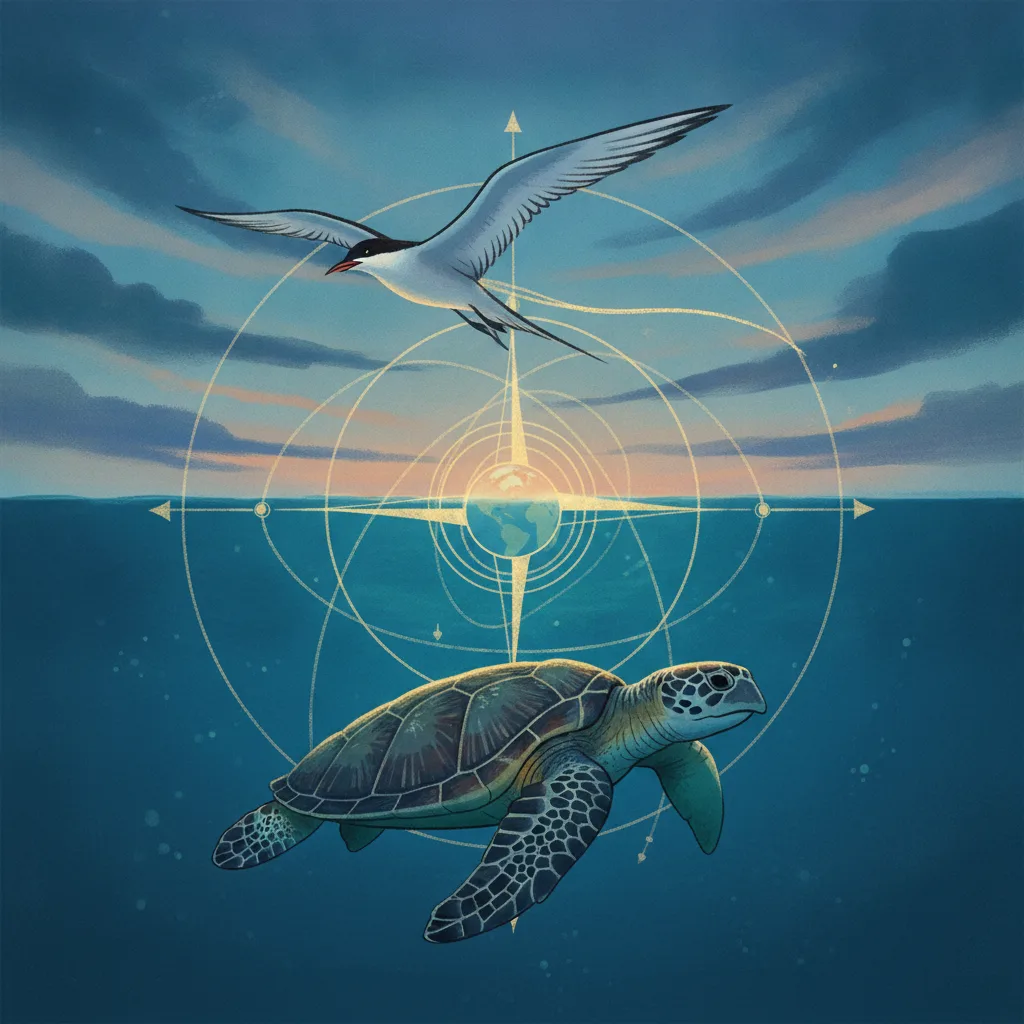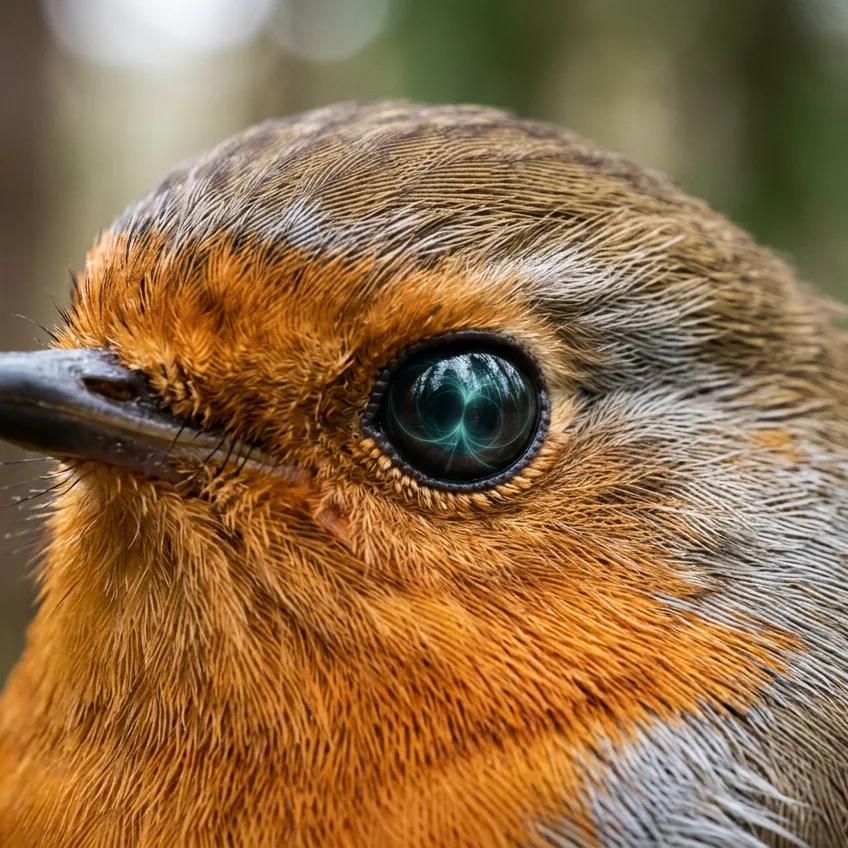
Every autumn, millions of small birds like the European robin (Erithacus rubecula) travel thousands of kilometers without getting lost, crossing continents at night and under dense cloud cover. For decades, it was a mystery how they managed to calibrate their orientation without visual landmarks, until quantum biology revealed fascinating machinery inside their eyes: a photoreceptor protein called cryptochrome 4 (Cry4).
Located in the photoreceptors of the avian retina, Cry4 operates through a purely quantum phenomenon known as the radical pair mechanism. When a blue light photon strikes the protein, it displaces an electron through a chain of tryptophan amino acids. This jump generates a pair of separated electrons whose quantum states (spins) remain correlated for fractions of a microsecond.
Even though Earth's magnetic field is extraordinarily weak (ranging between 30 and 60 microteslas, thousands of times weaker than a refrigerator magnet), it is enough to alter the balance between the singlet and triplet states of these electrons. This modulation alters the chemical signals sent to the brain via the optic nerve, suggesting that birds do not perceive magnetic north as a tactile sensation or an intuition, but literally see it as patterns of brightness, shadows, or shades overlaid on their normal field of view.
Source: Nature (Xu et al., 2021: 'Magnetic sensitivity of putative retinal cryptochrome 4 in a migratory bird')