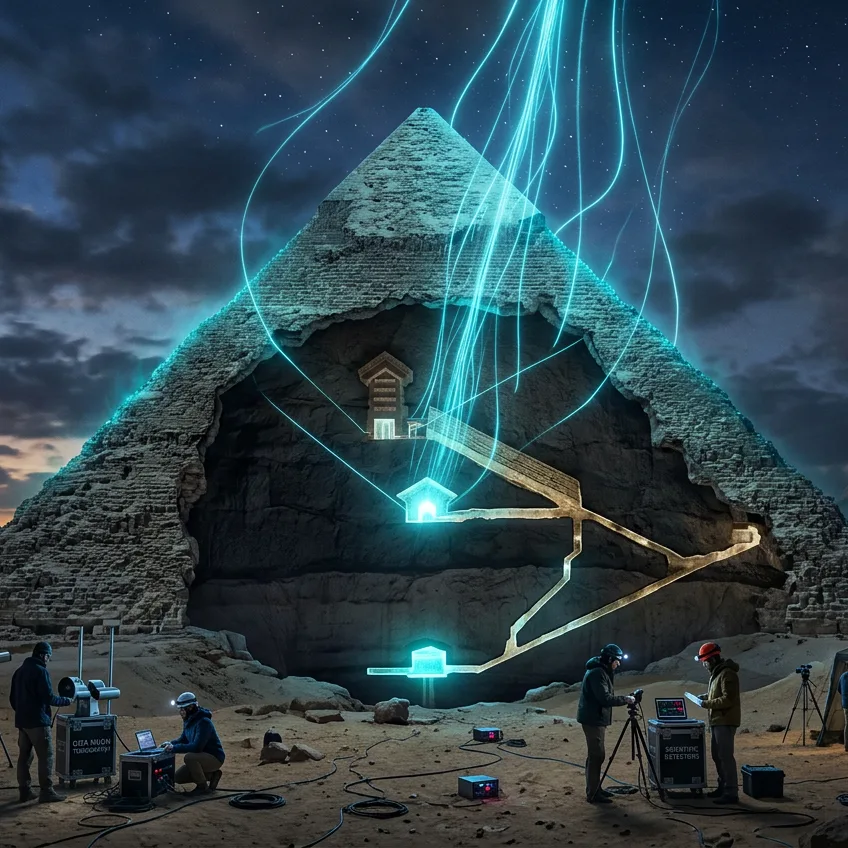
Every second, Earth is bombarded by high-energy cosmic rays originating from the far reaches of the universe. When colliding with atoms in the upper atmosphere, these particles generate a relentless shower of muons: elementary particles similar to electrons, but with a mass about 207 times greater. This impressive mass gives them astonishing penetration, allowing them to pass through hundreds of meters of solid rock before being absorbed or deflected.
Taking advantage of this phenomenon, scientists developed muography, a non-invasive imaging technique that functions exactly like a medical X-ray on a titanic scale:
- Density detection: By placing special muon detectors at the base or inside a structure, the number of particles that manage to cross it is measured. Hollow areas allow more muons to pass through, while dense rocks block a greater number.
- The great discovery in Giza: In 2017, the international project ScanPyramids used this technology to discover a secret cavity at least 30 meters long in the heart of the Great Pyramid of Khufu, hidden and untouched for more than 4,500 years.
- Volcanic monitoring: Geophysicists also install these sensors on the slopes of active volcanoes such as Mount Vesuvius or Etna to map magma movement in real time and predict eruptions.
Thanks to particles from deep space, modern science can explore the sealed interior of ancient monuments and geological hazards without excavating or altering historical heritage.
Source: Nature (Morishima et al., 2017: 'Discovery of a big void in Khufu's Pyramid by observation of cosmic-ray muons')