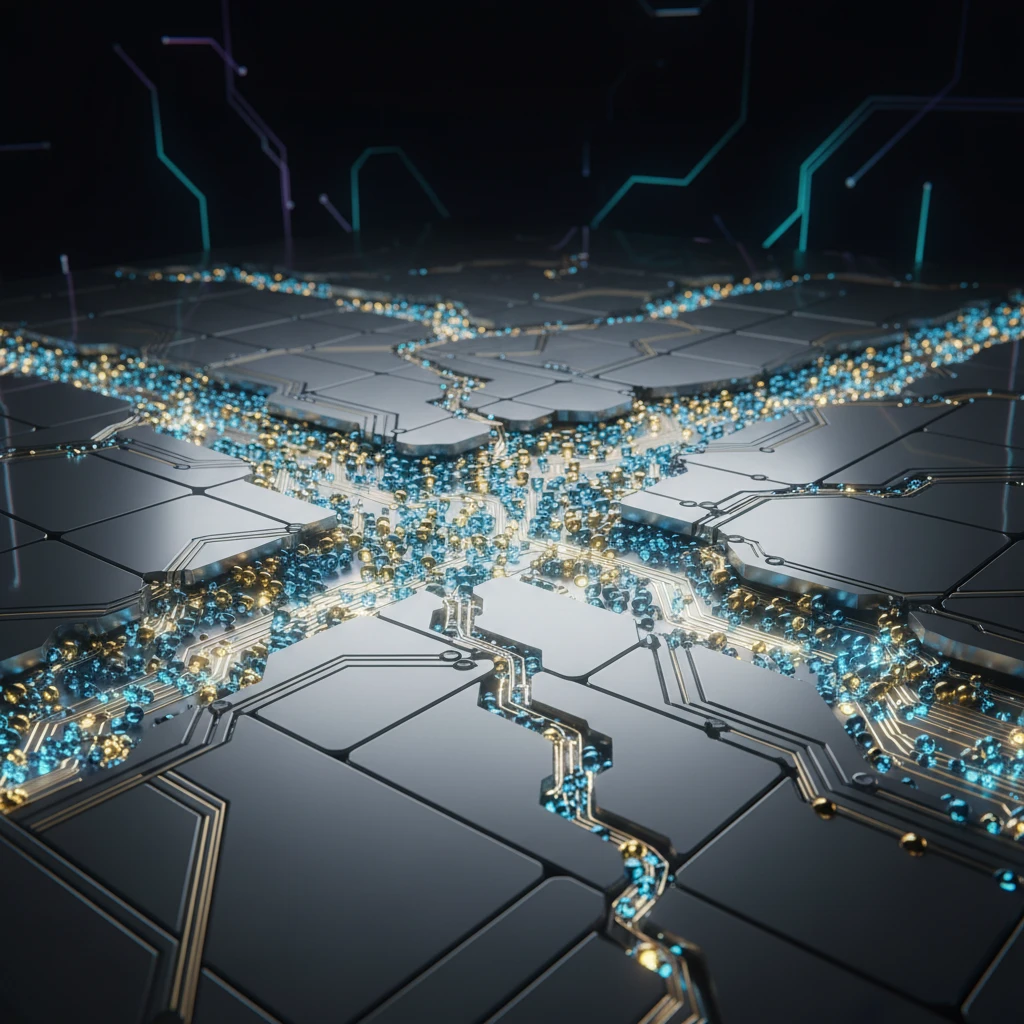
Every second, an invisible shower of subatomic particles passes through your body at nearly the speed of light. These are muons, elementary particles born when high-energy cosmic rays originating from supernovas and distant galaxies collide with molecules in Earth's atmosphere. Although they are heavy relatives of the electron and decay in microseconds, their immense relativistic energy allows them to penetrate hundreds of meters of solid rock before being absorbed.
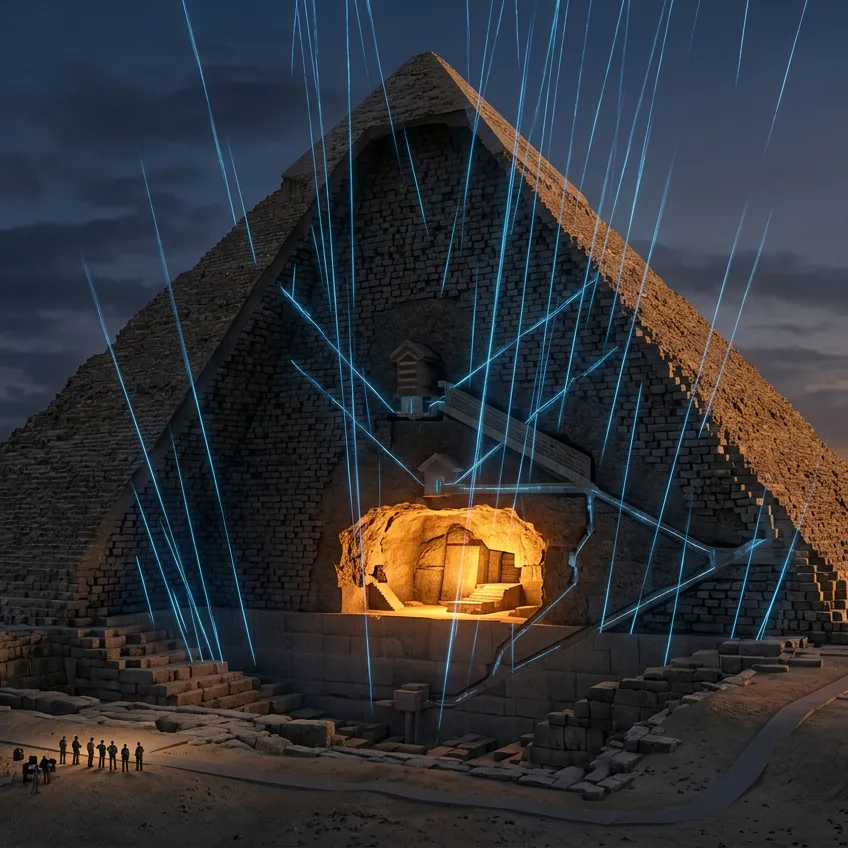
This extraordinary ability gave rise to muography, a discipline that works exactly like an X-ray on a titanic scale. If scientists place sensitive detectors beneath or beside a massive structure, dense rock sections stop more particles, while hollow spaces let more pass through. By measuring the resulting flow, researchers can reconstruct a three-dimensional map of the interior of impenetrable objects.
The most famous milestone of this technology occurred in 2017 through the ScanPyramids project. Researchers placed nuclear emulsion plates and gas trackers inside and around the Great Pyramid of Giza. Defying expectations, muons revealed a colossal hidden void over 30 meters long located right above the Grand Gallery, concealed for more than 4,500 years from conventional radar.
Today, muography also saves lives in modern volcanology: scientists in Japan and Italy install these sensors on the slopes of volcanoes such as Sakurajima or Vesuvius to monitor the rise of magma through internal conduits in real time, glimpsing Earth's interior thanks to particles born at the edge of the universe.
Source: Nature (Morishima et al., 2017 - Discovery of a big void in Khufu’s Pyramid by observation of cosmic-ray muons)