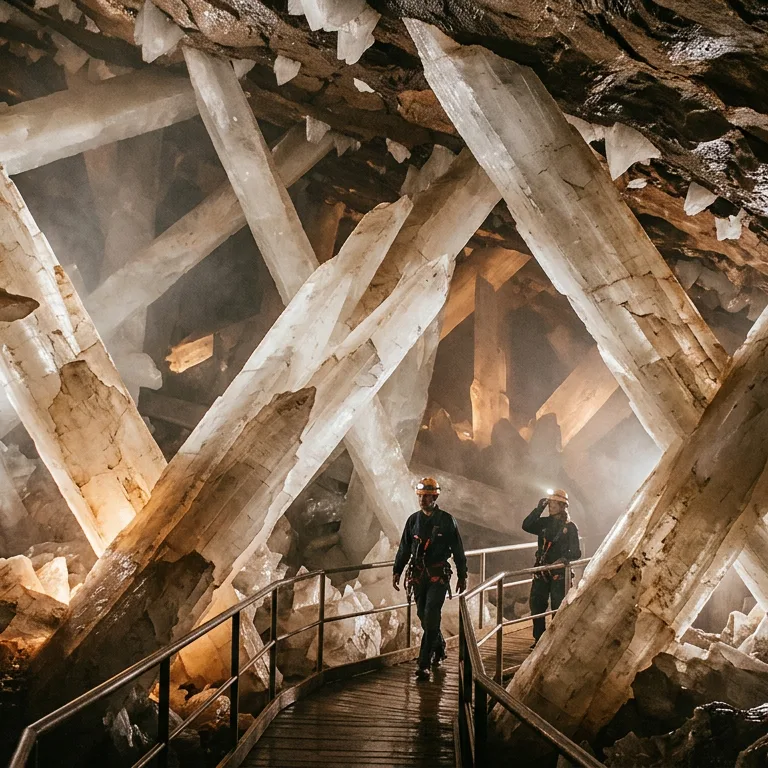
Three hundred meters beneath the surface of the Chihuahua Desert, in Mexico, hides one of the most astonishing geological landscapes on the planet: the Naica Cave of the Crystals. Discovered in 2000 by two miners excavating a drainage tunnel, this underground cavity houses selenite beams—a crystalline variety of gypsum—measuring up to twelve meters in length and weighing fifty-five tons, crossing the space like titanic glass bridges.
The origin of these mineral giants required an extraordinarily precise combination of thermodynamic factors:
- A dormant magma chamber: Several kilometers deep, an igneous intrusion kept the groundwater hot and saturated with calcium sulfate for millennia.
- The critical temperature: The water in the cave remained stable at about 54 °C for nearly half a million years. At that exact temperature, anhydrite becomes unstable and dissolves slowly, transferring its molecules to feed the continuous growth of gypsum.
- Ultra-slow-motion growth: The nucleation rate was minimal, preventing millions of small crystals from forming; instead, a few nuclei grew uninterrupted at a microscopic pace for five hundred millennia.
The interior of the cave is a death trap for humans: with temperatures reaching 58 °C and relative humidity up to 99%, air condenses in the lungs, preventing sweating. Without pressurized thermal suits equipped with ice backpacks, survival inside this natural laboratory did not exceed ten minutes.
Source: Geology (Geological Society of America) - 'Ultra-slow growth rates of giant gypsum crystals' (García-Ruiz et al.)