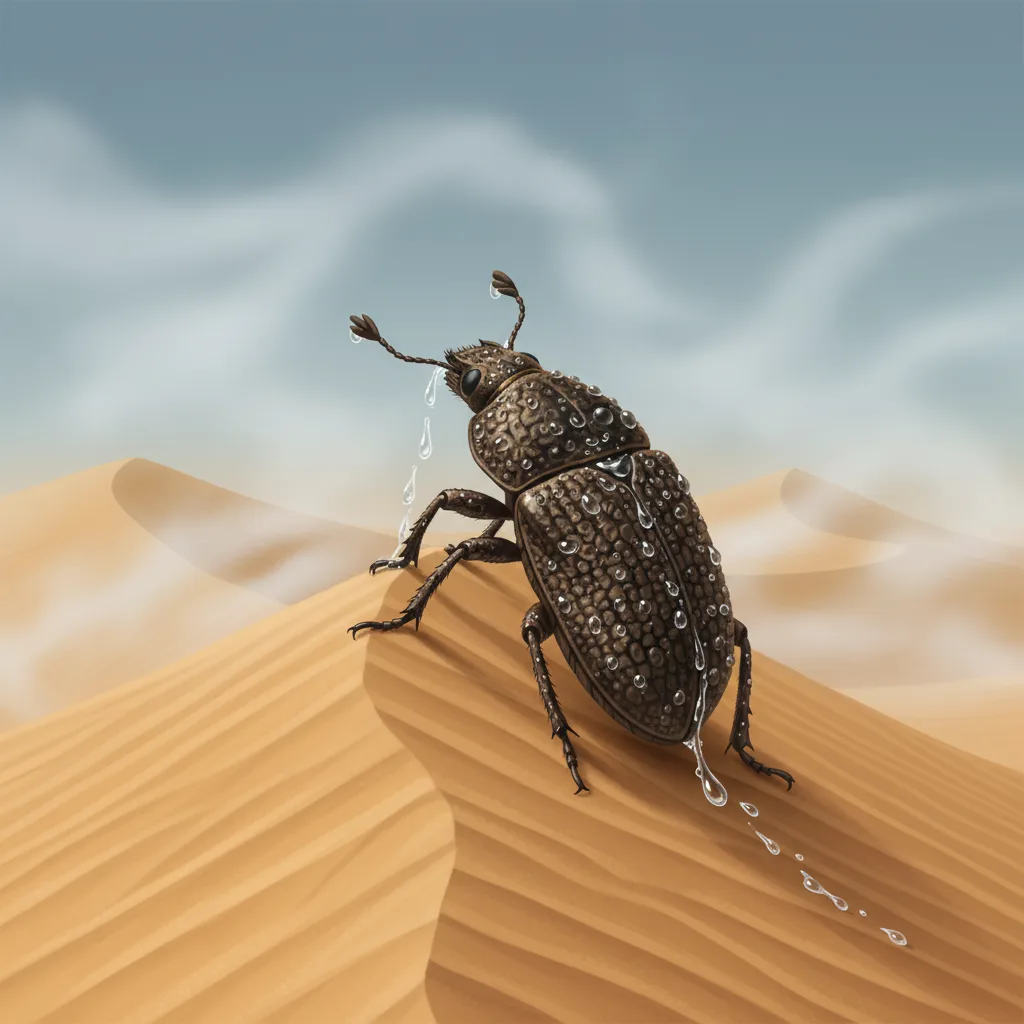
In the vast, arid expanses of the Namib Desert, where rainfall is scarce and the heat relentless, thrives one of the wonders of natural adaptation: the beetle Stenocara gracilipes. This small insect has solved the challenge of water survival with an astonishing biological innovation. Every morning, as coastal fog driven by the Atlantic wind rolls over the dunes, the beetle adopts a peculiar posture: it tilts its abdomen toward the sky.
The key to its success lies in the microstructure of its elytra (the hard coverings of its wings). The dorsal surface of its shell is not uniform; it is dotted with tiny hydrophilic (water-attracting) bumps surrounded by hydrophobic (water-repelling) valleys. When minuscule water droplets from the fog come into contact with the bumps, they cling and gather together. As the droplets grow by coalescence, their own weight forces them to roll down the wax-free hydrophobic channels, directly into the beetle's mouth. In this way, without drinking a single drop of rain, the Stenocara beetle collects enough water to survive and thrive.
This ingenious strategy, known as 'fog harvesting', is a testament to evolution and a source of inspiration for human engineering. Scientists and engineers study the bioarchitecture of the beetle's shell to develop biomimetic technologies, such as water-harvesting surfaces for arid regions or passive cooling systems. It is a reminder that, even in the most hostile environments, nature finds surprising paths for life.
Source: Biomimetics and ecology studies of the Namib Desert, publications in Nature and Science on animal adaptation.