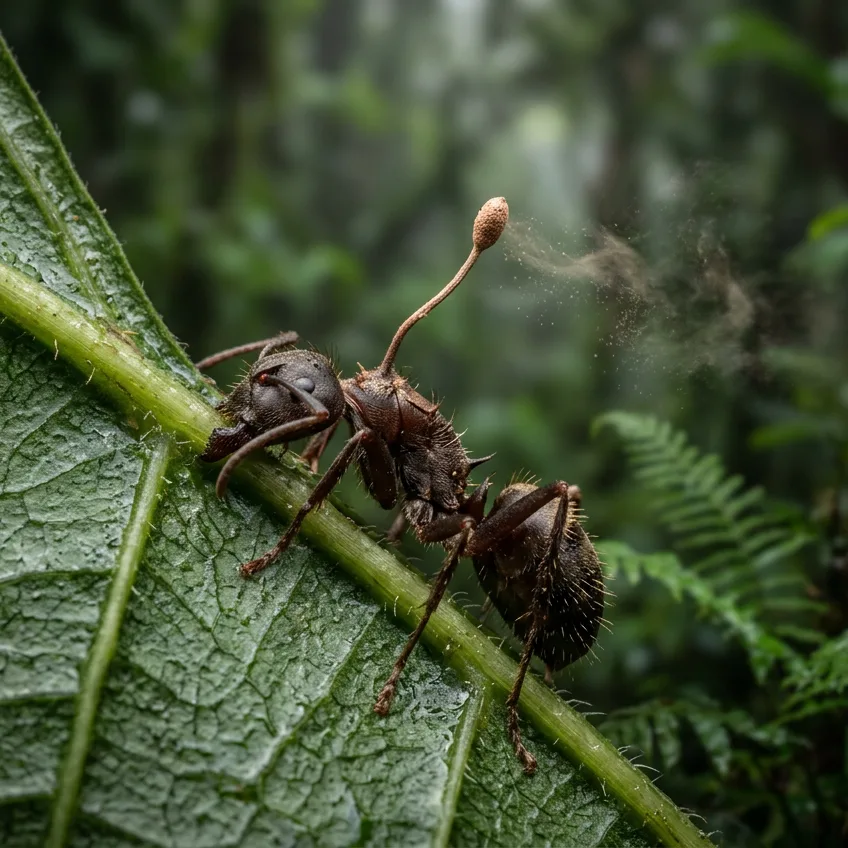
For decades, it was assumed that the parasitic fungus Ophiocordyceps unilateralis manipulated carpenter ants by invading and destroying their brain tissue. However, a landmark study led by Pennsylvania State University revealed a far more disturbing biological reality: the fungus does not need to infect the brain to direct the host's movements, but instead takes over its muscular system directly.
Using three-dimensional electron microscopy techniques combined with machine learning, the researchers mapped cellular interactions inside the insect. They discovered that fungal cells proliferate exponentially and fuse together, forming an interconnected biological network that colonizes muscle fibers in the legs, thorax, and mandibles. This parasitic mass acts like a system of biological cables that operates the exoskeleton through local chemical signals.
The precision of this motor manipulation is relentless:
- Forced navigation: The fungal network forces the insect to leave its nest and climb up a plant until it is located exactly about 25 centimeters above the ground.
- The death grip: It triggers an extreme, irreversible muscle contraction in the mandibles, locking the ant onto the main vein on the underside of a north-facing leaf.
- Isolated brain: Throughout the entire forced journey, the ant's brain remains intact and structurally free of fungal hyphae.
After securing anchorage in the ideal microclimate of humidity and temperature, the parasite consumes the remaining organs and emerges through the insect's head as a spore-bearing stalk, ready to rain millions of spores down onto the colony trails below.
Source: Proceedings of the National Academy of Sciences (PNAS) / Penn State University (2017)