The idea of a "tractor beam" capable of holding and moving matter without touching it seemed exclusive to science fiction until physicist Arthur Ashkin made it a reality in the microscopic universe. Developed at Bell Laboratories and awarded the Nobel Prize in Physics in 2018, optical tweezers make it possible to manipulate objects at the cellular scale using solely photons of laser light.
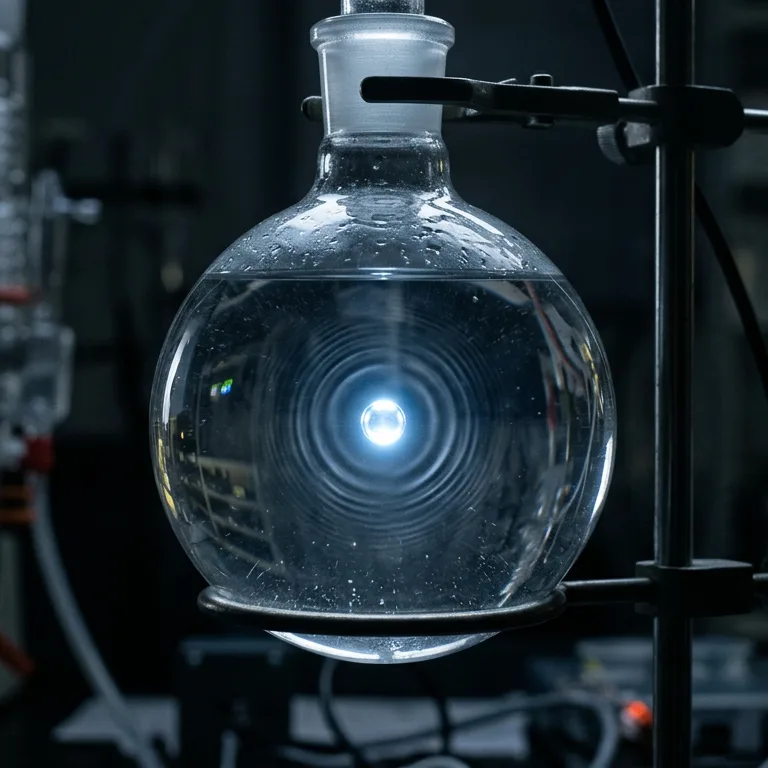
The secret of this instrument lies in radiation pressure: although light lacks rest mass, photons carry momentum. When a highly focused laser beam passes through a transparent microparticle—such as a silica sphere, a bacterium, or a virus—the light refracts and deflects its trajectory. By conservation of momentum, the particle experiences an opposing reaction force that pushes it directly toward the area of greatest light intensity at the focus, remaining suspended in a three-dimensional optical trap.
Ashkin discovered that using infrared lasers allowed him to trap living microorganisms without cooking or damaging them. The mechanical forces generated by these tweezers are on the order of piconewtons (a trillionth of a newton), exactly the magnitude governing biological machinery. Thanks to this technique, researchers have achieved unprecedented feats:
- Measuring the eight-nanometer steps taken by the protein kinesin when transporting cellular organelles.
- Holding both ends of a single DNA molecule to study its elasticity and unwinding.
- Moving organelles inside living cells without puncturing the plasma membrane.
Source: Nobel Prize Outreach / Bell Laboratories Archives (Ashkin, A. 'Acceleration and Trapping of Particles by Radiation Pressure', Physical Review Letters)