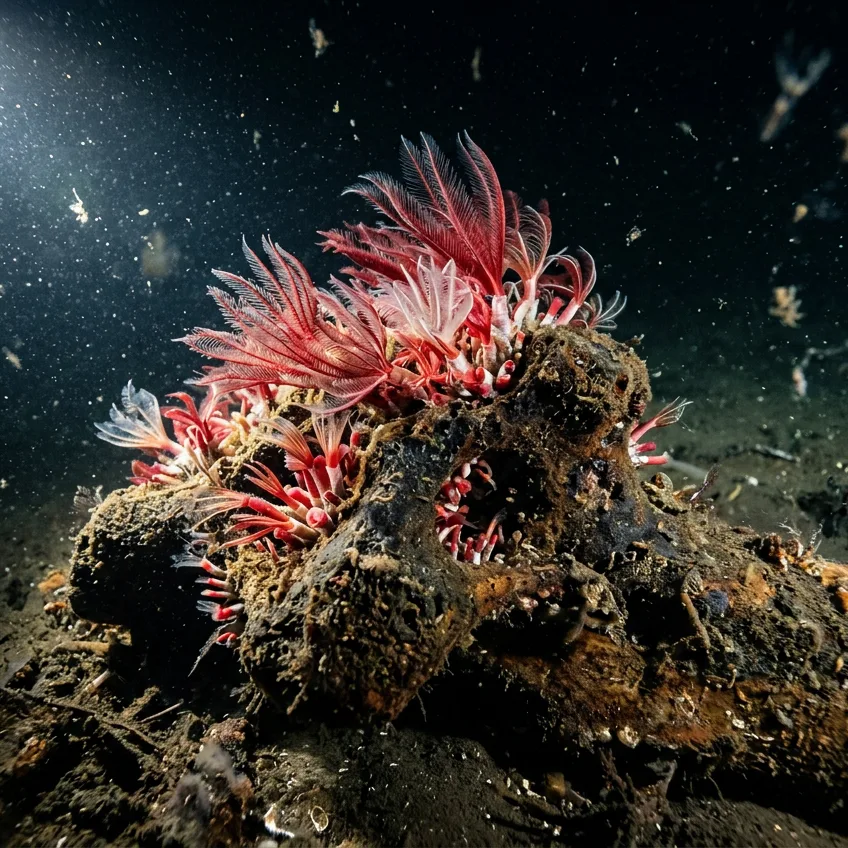
On abyssal plains, when the carcass of a large cetacean sinks to the seafloor—an event known in marine ecology as a whale fall—one of the ocean's most complex biological feasts begins. Among the most astonishing organisms that colonize these remains are annelids of the genus Osedax, whose Latin name literally means "bone-eaters."
Discovered in 2002 by biologists in Monterey Canyon (California), these invertebrates defy conventional anatomy: they completely lack a mouth, stomach, and anus. To feed on the calcium and collagen trapped in the bones, they spread a dense network of vascular roots that bores into the bone structure by actively secreting acid via cellular proton pumps. As they break down the inorganic matrix, a massive population of symbiotic bacteria from the family Oceanospirillaceae, housed in their root tissues, metabolizes the released lipids and proteins to nourish the worm.
Their reproductive dynamics are another evolutionary marvel. All visible worms waving their feathery gill plumes over the bones are exclusively female. The males undergo extreme sexual dwarfism: they never leave the larval stage, measure fractions of a millimeter, and live crowded by the dozens or hundreds inside the gelatinous tube of a single female, surviving on the remains of their yolk sac with the sole purpose of continuously fertilizing her eggs.
Source: Science / Monterey Bay Aquarium Research Institute (MBARI)