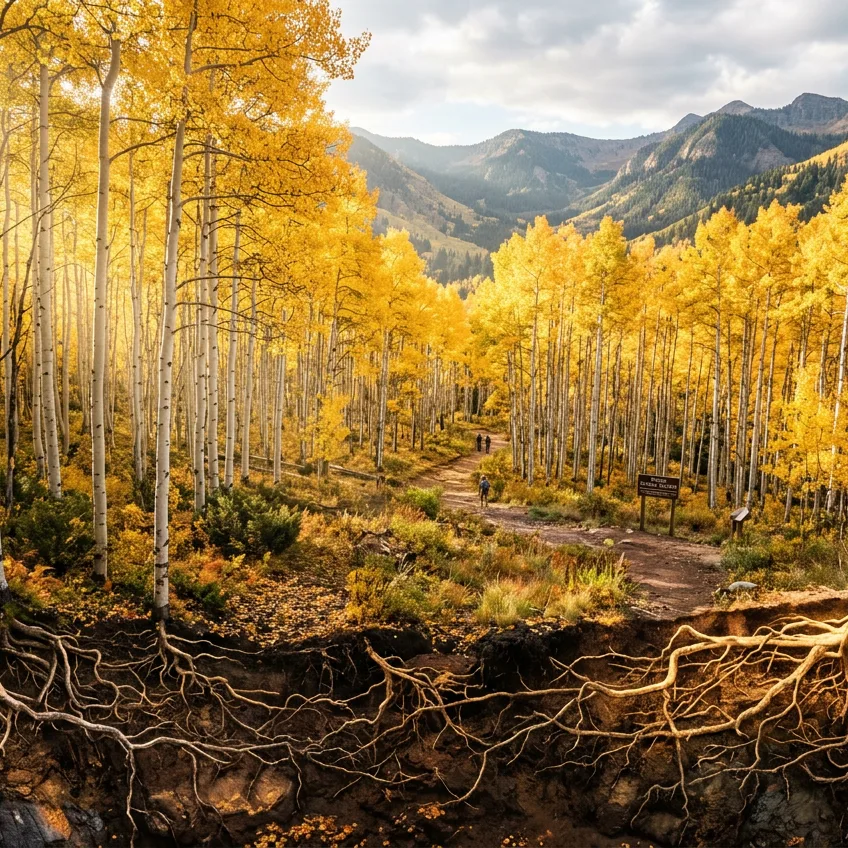
In Utah's Fishlake National Forest stands what appears at first glance to be an immense grove of quaking aspens (Populus tremuloides). However, this forest known as Pando (from the Latin "I spread out") is not made up of separate individuals: it is a single massive clone interconnected by a colossal underground root system.
Each of its more than 40,000 trunks is biologically a genetically identical stem or shoot born from the same root network. Spanning over 43 hectares and with an estimated weight exceeding 6,000 tons, Pando holds the undisputed record as the heaviest individual organism on our planet, far surpassing the blue whale and any giant sequoia.
Genetic analyses date the origin of this superorganism back at least 9,000 to 14,000 years, at the end of the last ice age, although some hypotheses suggest it may be even older. Through its shared roots, different sections of the forest actively redistribute water and nutrients; if one hillside experiences drought or leaf damage, healthy areas channel underground resources to compensate for the deficit.
Despite having survived millennia of wildfires because its vital core remains protected underground, Pando now faces challenges in rejuvenating due to overgrazing by deer eating the new shoots, prompting urgent scientific efforts to protect the most astonishing clonal giant in the plant kingdom.
Source: U.S. Forest Service / Nature Ecology & Evolution



