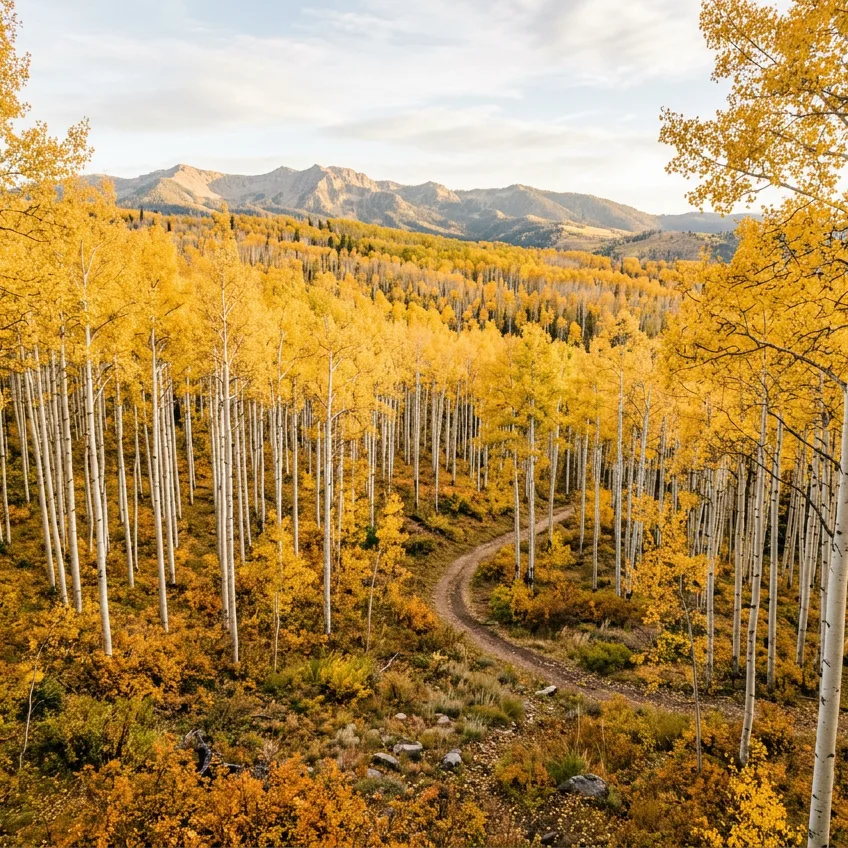
At first glance, the forest of Pando, located in Fishlake National Forest in Utah (United States), looks like a dense grove made up of more than 40,000 quaking aspens (Populus tremuloides). However, beneath the soil lies one of the planet's greatest biological wonders: every single trunk is part of a single, genetically identical living being, interconnected by a gigantic underground root network.
Its name comes from the Latin ("I spread out") and perfectly describes its reproductive strategy. Instead of relying on flowers or seeds, this male tree reproduces through vegetative cloning, sending up new vertical shoots from its shared root system. With an estimated mass of 6,000 metric tons and an area covering over 43 hectares, Pando is scientifically recognized as the heaviest living organism on Earth.
Among the most fascinating aspects of this botanical giant are:
- Colossal longevity: Although each individual trunk lives just over a century, the original root network has survived continuously for at least 8,000 to 12,000 years, since the end of the last ice age.
- Shared communication: The entire grove transfers water, nutrients, and pest-defense signals from one end to the other through its root circuit.
Despite having endured millennia of fires and droughts, today Pando faces its greatest challenge: overgrazing by deer and livestock prevents new shoots from maturing, prompting ambitious fencing and conservation projects to protect the world's most gigantic tree.
Source: U.S. Forest Service / Friends of Pando