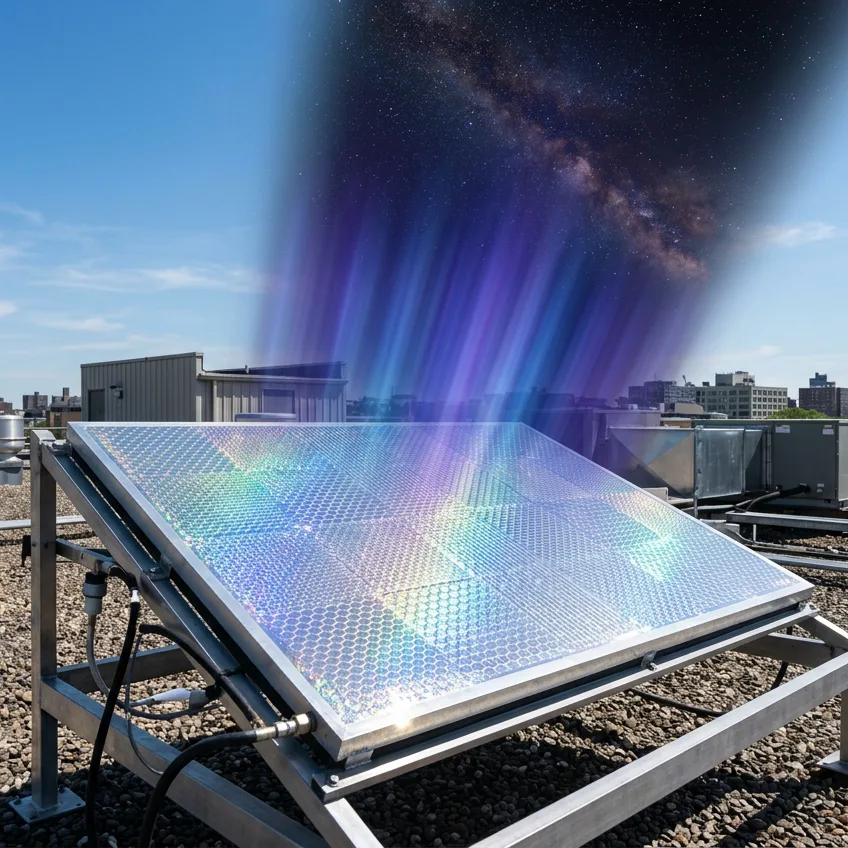
Is it possible to cool an object below ambient temperature in the middle of a summer midday without spending a single watt of energy? For centuries, everyday thermodynamics seemed to limit natural cooling to the night. However, in 2014, a team of physicists from Stanford University led by Shanhui Fan demonstrated that passive daytime radiative cooling is a tangible reality thanks to nanotechnology.
The secret of this phenomenon lies in taking advantage of a peculiarity of our atmosphere: the so-called infrared transmission window, a band of the electromagnetic spectrum located between 8 and 13 micrometers. In this range, atmospheric gases such as water vapor or carbon dioxide barely absorb heat; for those specific wavelengths, Earth's sky is practically transparent.
To exploit this thermal escape hatch, scientists designed metamaterials and multilayer films with two opposing optical properties that act in unison:
- Colossal solar reflectance: They bounce back more than 96 % of incident solar radiation, preventing the material from absorbing heat from the sun.
- Selective infrared emission: They expel their own thermal energy concentrated with millimeter precision in the 8 to 13 micrometer band.
By radiating heat at that exact frequency, thermal photons do not warm the air surrounding the panel; they travel in a straight line through the atmosphere and dissipate directly into the vacuum of deep space, which acts as a gigantic heat sink at 3 Kelvin (-270 °C). Thanks to this thermal bridge to the cosmos, these quantum mirrors manage to cool between 5 °C and 8 °C below ambient temperature under a blazing sun.
Source: Nature (Raman et al., 2014 - Passive radiative cooling below ambient air temperature under direct sunlight)