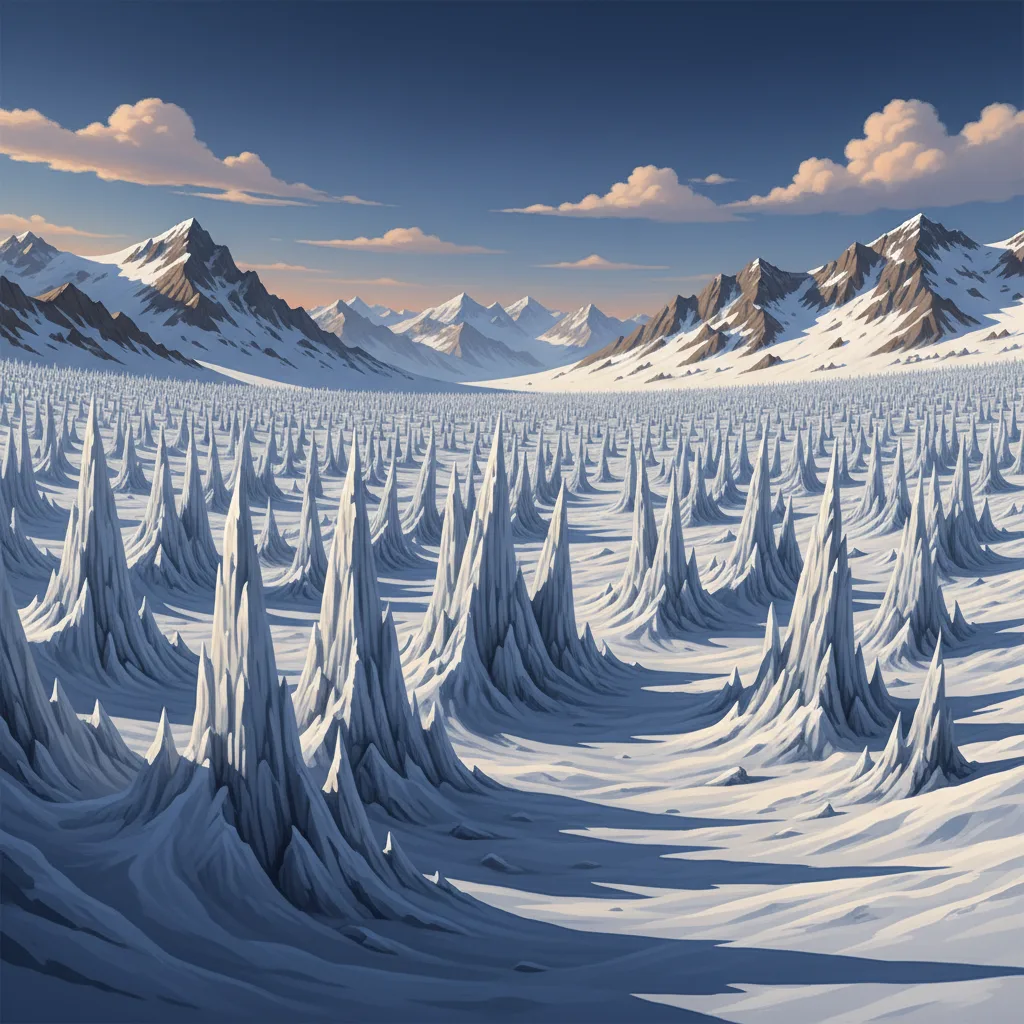
Imagine a mountain landscape where snow is not a uniform layer, but thousands of towering ice blades pointing to the sky, like figures kneeling in penance. These are "Penitentes," unique formations of snow and ice found at high altitudes in the Andes, the Himalayas, and other tropical and subtropical mountain ranges.
Discovered by Charles Darwin in 1835 during his expedition in the Chilean Andes, penitentes can vary in size, from a few centimeters to reaching impressive heights of more than 5 meters. Their formation is a complex ballet between the sun and the ice.
It all begins with small irregularities on the surface of the snow. Under intense high-altitude solar radiation, the ice does not melt, but instead sublimates directly into water vapor, a process that bypasses the liquid phase. The deeper depressions, once formed, act as traps for solar radiation, accelerating sublimation inside them. In contrast, the higher, exposed walls reflect more light and sublimate more slowly.
This cycle of absorption and reflection, along with dry, cold winds that sweep away the water vapor, gradually sculpts the surface of the ice, creating these sharp blades that look hand-carved. The result is a surreal field of peaks and ridges that can make travel extremely difficult for mountaineers and explorers, yet offers one of the most extraordinary sights in nature.
Penitentes are not only a visual wonder, but also a fascinating reminder of how subtle interactions of physics can create monumental structures in some of the most extreme environments on our planet.
Source: The American Journal of Science, Scientific American, National Geographic (Research on glaciology and cryosphere phenomena), Writings of Charles Darwin.