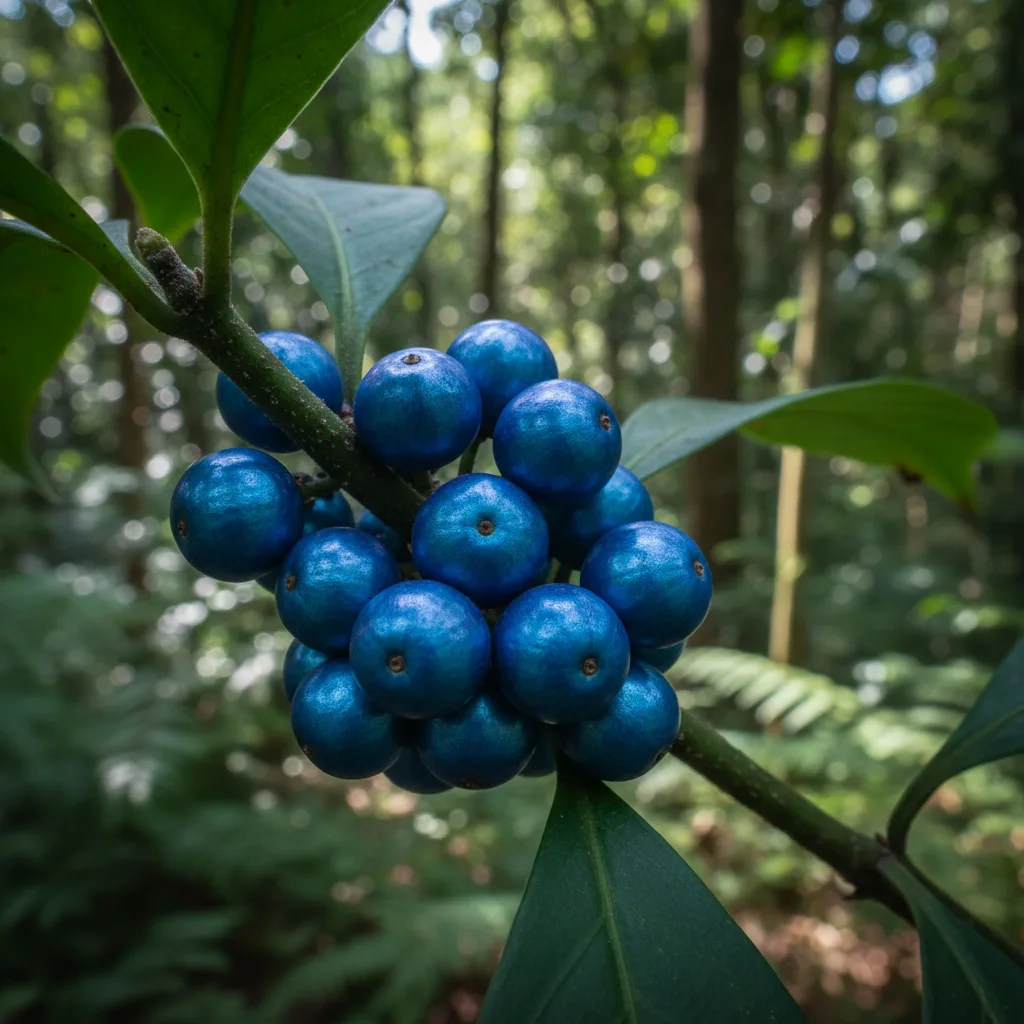
Found in the forests of Africa, the berry of Pollia condensata is a visual marvel that challenges our understanding of color. Its appearance is striking: an iridescent metallic blue, more vibrant and pure than any known pigment, and with an even more fascinating feature: its color never fades, even decades or centuries after being collected. Literally, it is an "eternal berry" that does not rot.
The secret to its intensity and durability does not lie in chemical pigments, but in sophisticated nanometric engineering. Instead of producing color molecules, Pollia condensata evolved to create a unique microscopic structure in the cells of its skin. These cells contain multiple layers of cellulose fibers, stacked in a right-handed helical arrangement. This special structure interacts with visible light, refracting it in a specific way known as Bragg scattering, which results in the brightest blue in nature.
Since the color is structural rather than chemical, the berries of Pollia condensata not only maintain their vivid blue indefinitely, but also exhibit fascinating iridescence, subtly changing hue depending on the angle of light. Although this fruit is not edible for humans and has very little nutritional value for most animals, its shine serves as a powerful visual lure. Birds, attracted by this natural "jewel," often rub their beaks against the berries, thus helping to disperse the tiny seeds they contain.
This marvel of natural nanotechnology is inspiring scientists and designers. Its principles are being investigated to develop new generations of paints, dyes, and optical materials with ultra-bright, durable colors, as well as advanced security systems that replicate the steadfast vitality and permanence of this extraordinary natural blue.
Source: Journal of the Royal Society Interface / Nature Photonics