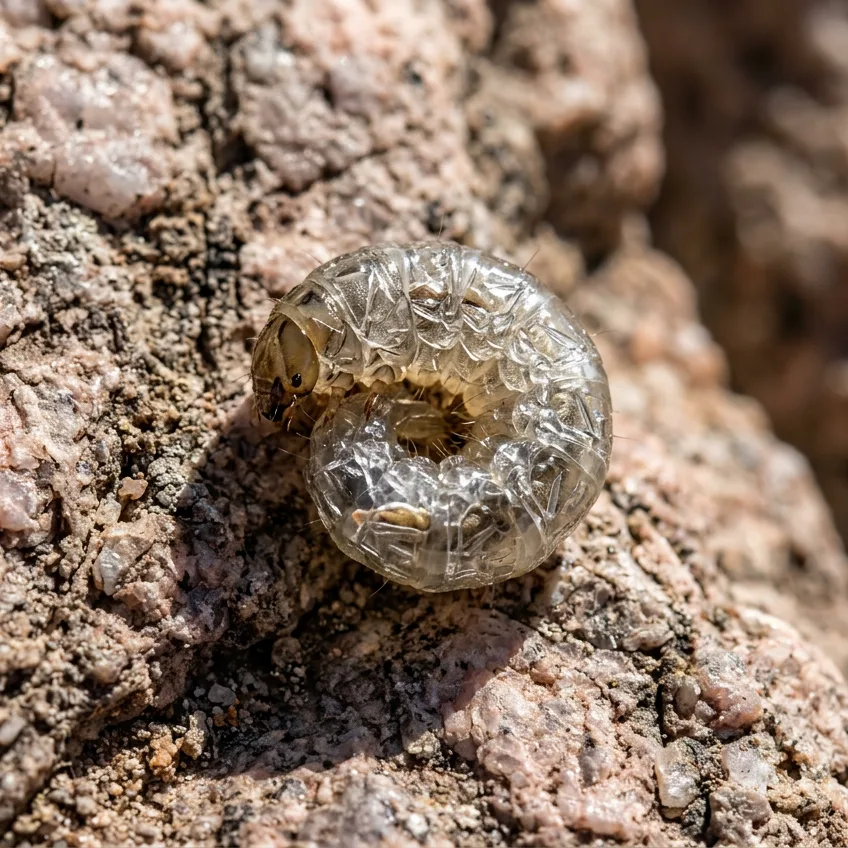
In temporary rock pools across sub-Saharan Africa lives a tiny non-biting midge whose life cycle defies the laws of survival: Polypedilum vanderplanki. When the scorching sun evaporates the water in its habitat, its larva does not die; instead, it triggers an extreme process called anhydrobiosis, expelling up to 97% of the water from its body.
To prevent its cells from collapsing during desiccation, the insect replaces its body fluids with trehalose (a protective sugar) and LEA proteins. This mixture transforms the interior of its tissues into a solid yet biologically inert glass-like structure, a state known as cellular vitrification. In this suspended animation, its metabolism drops to virtually undetectable levels, stopping the biological clock entirely.
What is astonishing is the resistance it acquires in that glassy state:
- Extreme temperatures: It withstands direct immersion in liquid helium at -270 °C and sustained heat above 100 °C.
- Crushing radiation: It tolerates doses of gamma radiation exceeding 7,000 grays, lethal to almost any multicellular life form.
- Space exposure: In tests conducted outside the International Space Station (ISS), desiccated specimens survived the cosmic vacuum and pure ultraviolet radiation.
Upon coming into contact with liquid water again, the larvae rehydrate and reactivate enzymes that repair their fragmented DNA. In under 48 hours, they crawl normally once more, ready to metamorphose into adult midges.
Source: Nature Communications / PNAS (Proceedings of the National Academy of Sciences)



