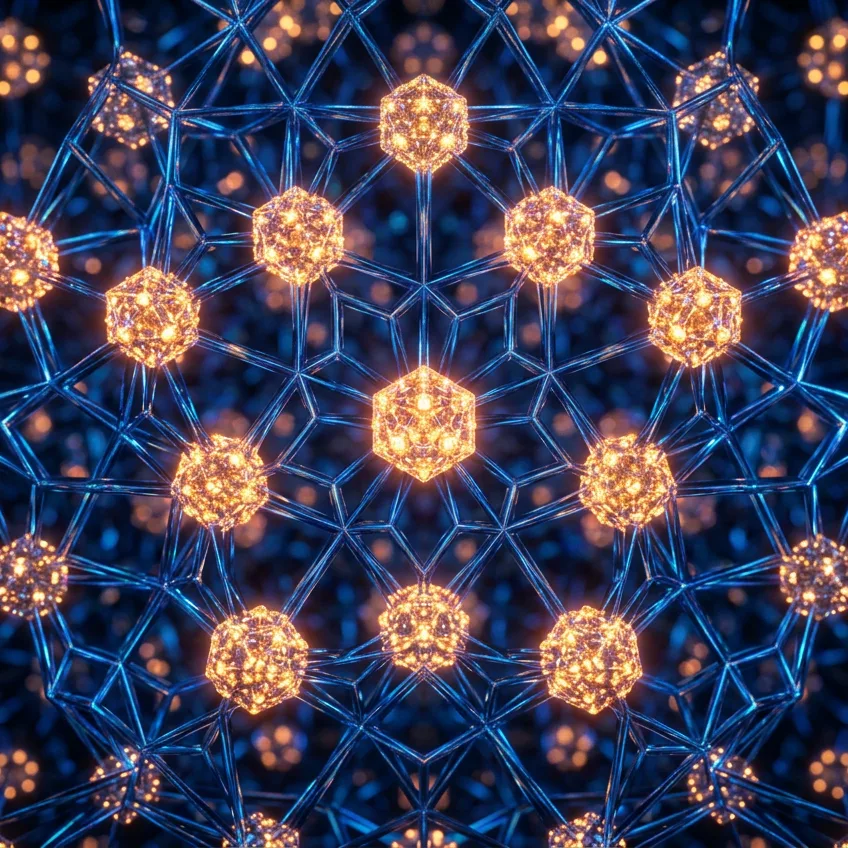
On April 8, 1982, while analyzing an aluminum-manganese alloy with an electron microscope at the US NIST laboratories, physicist Dan Shechtman observed an inconceivable diffraction pattern: the dots formed a ten-fold rotational symmetry.
For two centuries, classical crystallography had defended an unbreakable dogma: crystalline matter could only be organized through periodic lattices that repeated periodically in space, like tiles on a floor. Mathematically, five- or ten-fold symmetry was considered impossible, just as a continuous surface cannot be tiled using only regular pentagons without leaving empty gaps.
The finding sparked intense controversy. Celebrated two-time Nobel laureate Linus Pauling openly attacked his work at scientific conferences, going so far as to declare: "There are no quasicrystals, only quasi-scientists". Shechtman was marginalized by several colleagues and even asked to leave his research group after being accused of bringing disgrace upon the laboratory.
Shechtman did not back down. His observation proved the existence of a state of matter with aperiodic order: atoms arrange themselves according to rigorous mathematical proportions based on the golden ratio and Roger Penrose's tilings, but the pattern never repeats translationally.
Definitive confirmation was solidified with the 2009 discovery of naturally occurring quasicrystals in the Khatyrka meteorite in Siberia. By 2011, the International Union of Crystallography had already formally redefined the concept of a crystal, and Shechtman was awarded the Nobel Prize in Chemistry alone, sealing one of the most extraordinary empirical triumphs over skepticism in modern science.
Source: The Royal Swedish Academy of Sciences - The Nobel Prize in Chemistry 2011 (Dan Shechtman)