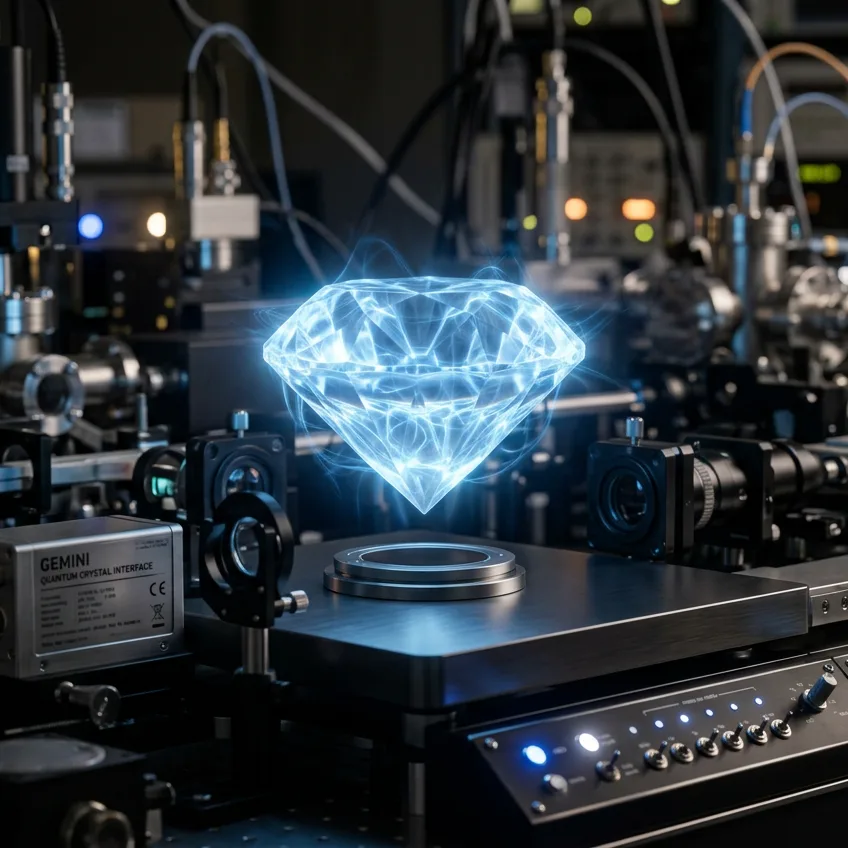
Is it possible to transform tons of hazardous radioactive waste into a perpetual and safe battery? In 2016, a team of physicists and chemists from the University of Bristol proved that it is, presenting a revolutionary invention: the diamond betavoltaic battery.
The system takes advantage of graphite blocks used as moderators in nuclear reactors, which absorb radiation and accumulate huge concentrations of the isotope carbon-14. Instead of storing this waste for millennia, scientists heat the graphite to extract the radioactive carbon as a gas and crystallize it through chemical vapor deposition, forging a semiconducting synthetic diamond.
As carbon-14 decays inside the gem, it emits beta particles (high-energy electrons). By colliding with the diamond's crystalline lattice, charge carriers are released, creating a continuous electric current without moving mechanical parts or chemical reactions that degrade. To ensure total safety, the core is encapsulated within a second layer of non-radioactive pure diamond, the hardest substance on Earth, which completely absorbs any residual radiation.
Although its power is measured in microwatts, its lifespan challenges current technology: since the half-life of carbon-14 is 5,730 years, the device would take nearly six millennia to lose half of its energy. This technology promises to power pacemakers that never need to be surgically replaced, sensors in abyssal trenches, and space probes destined to explore the cosmos for generations.
Source: University of Bristol / Cabot Institute for the Environment