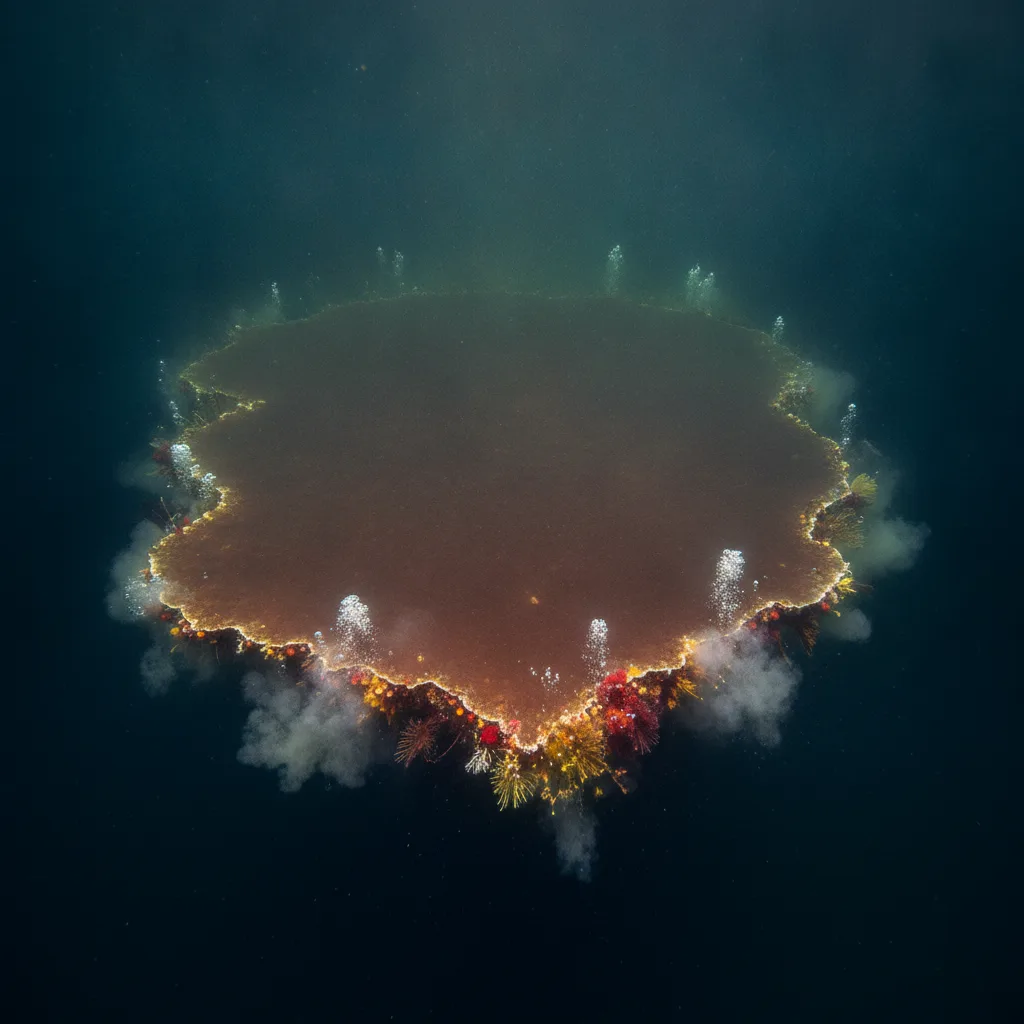
Imagine a lake, but under the sea. In the ocean depths, where sunlight never reaches, there are extraordinary geological phenomena known as "brine lakes" or "brine pools." These depressions on the seafloor are filled with hypersaline water, often with a salt concentration up to five times higher than the surrounding seawater. This extreme density prevents them from mixing, creating sharp and visually striking boundaries, as if they were lakes or rivers with their own "shores" and "surfaces" underwater.
They form when seawater seeps through salt rocks in the seafloor, dissolving salts and minerals. Then, this dense and heavy brine pools in depressions, often accompanied by methane or other toxic gases. For most marine creatures, venturing into these brine lakes is deadly; the high salinity and lack of oxygen are toxic. Fish and other animals that swim into them suffer osmotic shock and die, sometimes creating "graveyards" around their edges.
However, these hostile environments are not devoid of life. Around the edges of these brine lakes, scientists have discovered unique ecosystems of bacteria, archaea, and specialized worms that have evolved to tolerate or even thrive in these extreme conditions. These creatures often rely on chemosynthesis, using chemical compounds such as methane seeping from the lakes, rather than sunlight. Studying these ecosystems offers us a fascinating look at how life might exist on other planets with similarly extreme conditions.
Source: Woods Hole Oceanographic Institution, NOAA, Nature Geoscience



