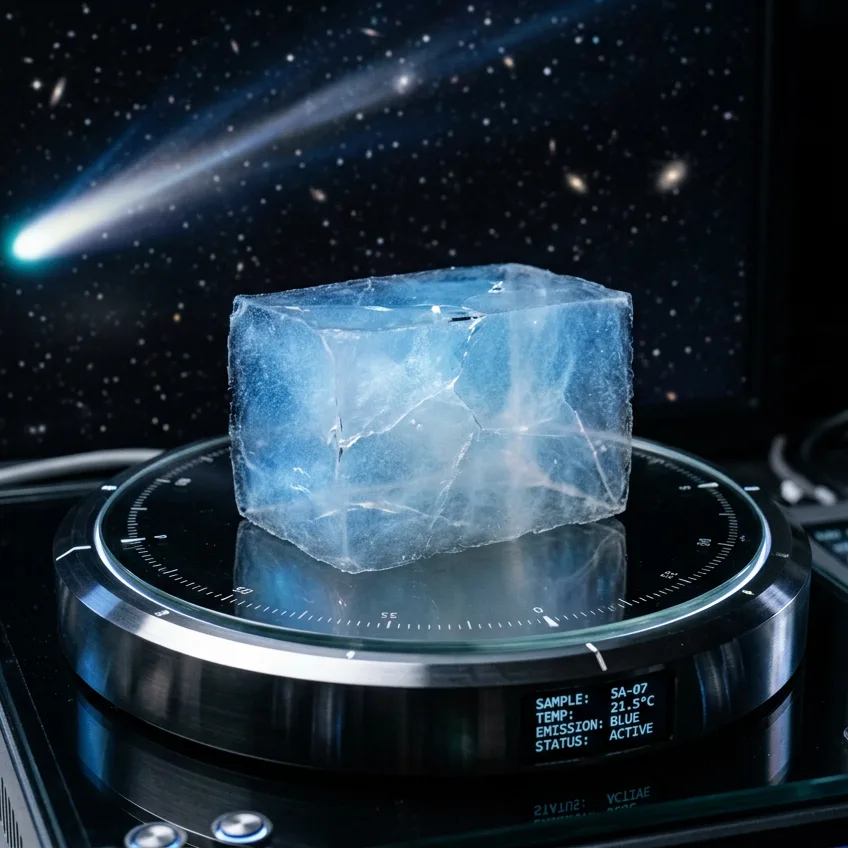
In 1931, American chemist Samuel Stephens Kistler won a scientific bet: proving it was possible to extract the liquid from a gel and replace it with gas without its molecular structure collapsing. Through an innovative supercritical drying process, Kistler created silica aerogel, a synthetic substance so ethereal and translucent that it was soon dubbed "frozen smoke."
Composed of up to 99.8% air trapped in a nanoporous silicon dioxide matrix, aerogel boasts extreme physical properties. Its thermal conductivity is practically zero: a flower or a crayon resting on a thin sheet of aerogel remains intact even when exposed from below to the direct flame of a blowtorch at over 1,000 °C. However, its most astonishing application occurred in outer space during NASA's Stardust mission in 1999.
The goal was to capture dust samples from comet Wild 2. The dilemma seemed insoluble: catching cosmic particles traveling at 6.1 kilometers per second (more than 21,000 km/h) against a traditional surface would instantly vaporize them due to friction. The solution was to build a collector with aerogel panels:
- Upon penetrating the spongy silica structure, the microscopic particles gradually lose kinetic energy.
- The material collapses gently in their wake, carving tiny carrot-shaped conical tracks.
- The cosmic grain slows to a stop in just a few millimeters without melting or altering its pristine chemical composition.
Thanks to this nearly weightless material, in 2006 science recovered the first intact samples of cometary dust ever analyzed on Earth.
Source: NASA Jet Propulsion Laboratory (JPL) - Stardust Mission Archives