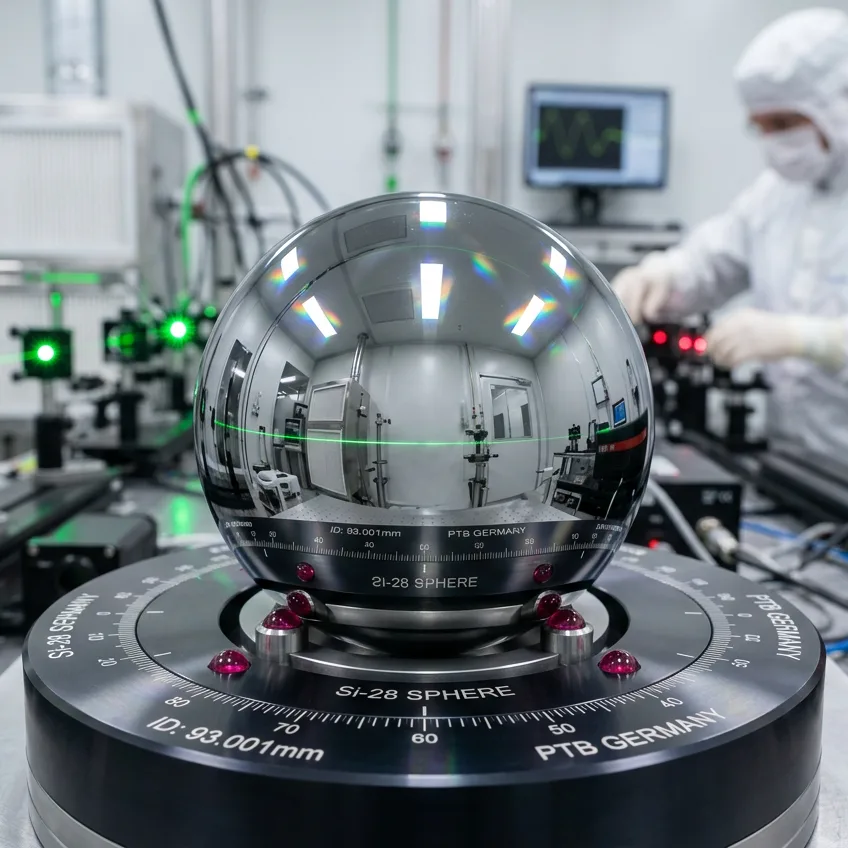
How can something practically perfect be made? To retire once and for all the old standard platinum-iridium cylinder kept in Paris and redefine the kilogram based on fundamental constants, scientists from the Avogadro Project needed to count atoms with absolute accuracy. To achieve this, they created the most flawless spherical object ever manufactured by humanity: a pure silicon ball weighing exactly one kilogram.
The material is no ordinary silicon. It is a single crystal purified in Russian centrifuges to reach an isotopic purity of 99.9995 % of silicon-28, eliminating any irregularity in the crystal lattice. Later, master opticians from the CSIRO center in Australia spent months polishing it by hand and with ultra-precision machinery. The result is astonishing:
- Atomic tolerance: Its diameter of approximately 93.7 millimeters varies by no more than a few tens of nanometers at any point on its surface.
- Planetary scale: If this sphere were artificially enlarged to the size of planet Earth, the distance between the deepest valley and the highest peak would be less than five meters.
- Exact counting: Thanks to laser interferometry and X-ray diffraction, researchers were able to measure the distance between its atoms to fix the Avogadro constant with an uncertainty of barely two parts per hundred million.
Although the International System formally fixed mass through the Kibble balance and the Planck constant in 2019, these silicon spheres remain guarded as primary standards and as the unsurpassed pinnacle of human engineering precision.
Source: Physikalisch-Technische Bundesanstalt (PTB) & Australian Commonwealth Scientific and Industrial Research Organisation (CSIRO)