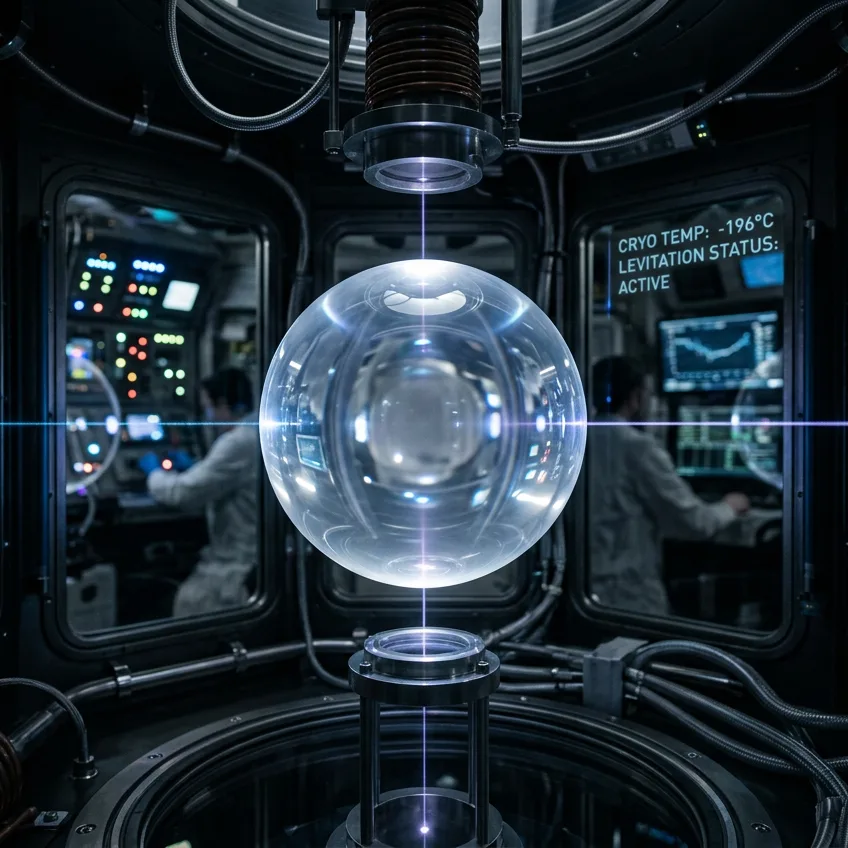
To test one of the most elusive predictions of Albert Einstein's General Relativity—the dragging of spacetime produced by Earth's rotation, known as the Lense-Thirring effect—NASA and Stanford University developed the Gravity Probe B mission. To measure a nearly infinitesimal angular deviation, scientists needed to create the most precise mechanical components in history.
The core of the satellite, launched in 2004 after four decades of development, incorporated four gyroscopes formed by fused quartz spheres the size of table tennis balls (3.8 centimeters in diameter). Their roundness was so colossally perfect that they did not deviate from a mathematically pure sphere by more than 40 layers of atoms. In other words: if one of these spheres were scaled up to the size of planet Earth, the highest mountain range or the deepest ocean trench would not exceed two meters in height.
Each sphere was polished for more than a year and coated with a superconducting layer of niobium of microscopic thickness. In space, suspended by electrostatic fields inside a cryogenic container at 1.8 Kelvin (−271 °C) and in ultra-high vacuum, they spun at several thousand revolutions per minute without any physical contact. Using ultra-precise quantum magnetic sensors (SQUIDs) that tracked the tiny London moment induced by their rotation, the mission resoundingly confirmed how our planet's spin literally drags the cosmic fabric that surrounds it.
Source: NASA / Stanford University (Gravity Probe B Final Results, Physical Review Letters)