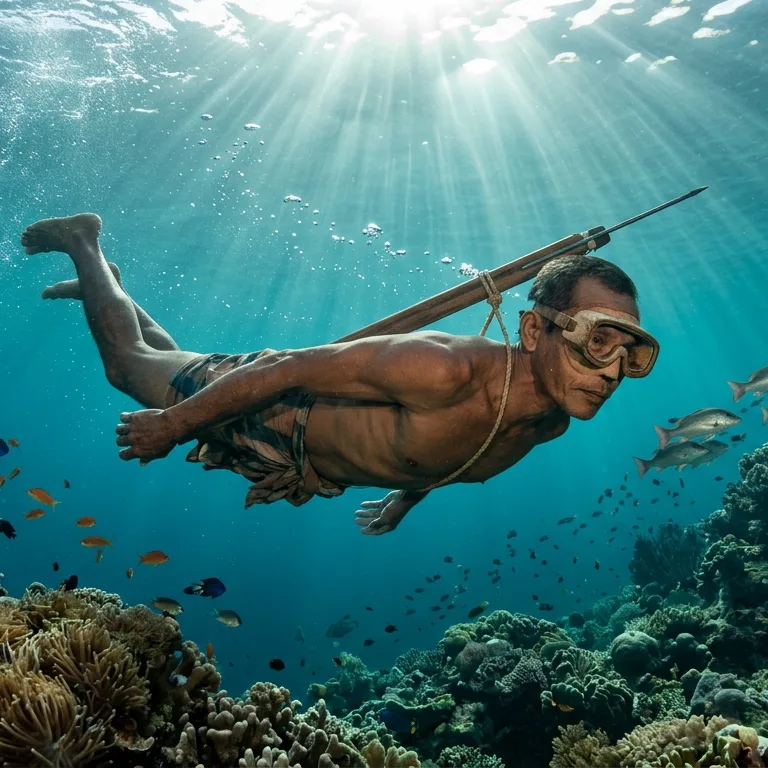
For over one thousand years, the Bajau people of Southeast Asia have lived on houseboats across the waters of Indonesia, Malaysia, and the Philippines. Known as the "sea nomads," these underwater hunters spend up to 60% of their workday submerged, reaching depths of more than 70 meters equipped only with wooden goggles and handcrafted spears. However, this is not just rigorous physical training: their bodies have genetically evolved to house an internal "oxygen tank."
In 2018, a study led by geneticist Melissa Ilardo and published in the journal Cell revealed the biological secret of the Bajau: they possess a spleen 50% larger than that of related land-dwelling populations, such as the Saluan. The spleen acts as a crucial reservoir of mature, oxygenated erythrocytes. When a person dives, the mammalian dive reflex contracts this organ to release a sudden surge of red blood cells into the bloodstream, increasing available oxygen levels by up to 10%.
DNA analysis revealed that this enlargement does not come from practicing diving since childhood, as tribe members who never swim also display colossal spleens. The key lies in an alteration in the PDE10A gene, which regulates the thyroid hormones controlling the size of this organ. This is the first proven evidence of a genetic and anatomical adaptation in modern humans to the freediving environment.
Source: Cell (Ilardo et al., 2018: 'Physiological and Genetic Adaptations to Diving in Sea Nomads')