Every time a neuron fires an electrical signal in your brain or a muscle fiber in your heart contracts, it generates a tiny electrical current. With that current comes an imperceptible magnetic field, so weak that it ranges between femtoteslas (10⁻¹⁵ T) and picoteslas. To put it into perspective, Earth's natural magnetic field is about one billion times stronger. Recording these biological signals from outside the skull seemed physically impossible until the invention of SQUIDs (Superconducting Quantum Interference Device).
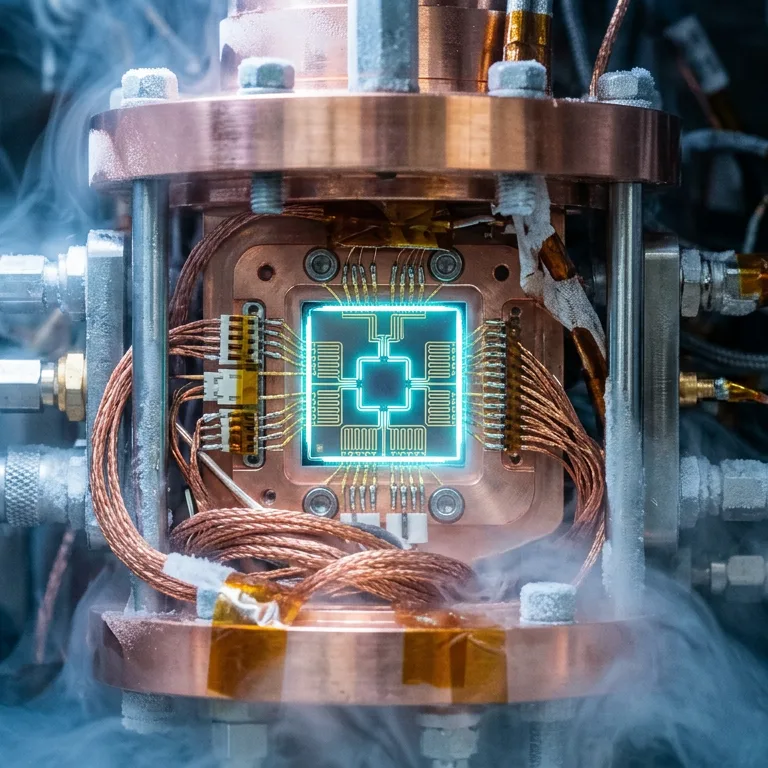
The core of a SQUID sensor consists of a ring of superconducting material interrupted by one or two extremely thin barriers known as Josephson junctions. At temperatures near absolute zero—around -269 °C using liquid helium—electrons pair up to form what are known as Cooper pairs, which can cross these insulating barriers through the phenomenon of quantum tunneling.
When a minuscule magnetic field passes through the superconducting ring, it alters the phase of the electrons' quantum wave, producing an interference measurable with superhuman precision:
- Extreme sensitivity: They can record magnetic variations down to 10⁻¹⁸ teslas, the most sensitive scale ever achieved by human instrumentation.
- Magnetoencephalography (MEG): They map brain activity millisecond by millisecond in real time, observing which neural circuits light up in response to a word or a memory.
- Geophysics and space exploration: They are used to detect underground mineral deposits, microscopic cracks in nuclear submarines, and signs of gravitational waves.
Source: Nature Reviews Physics / National Institute of Standards and Technology (NIST)