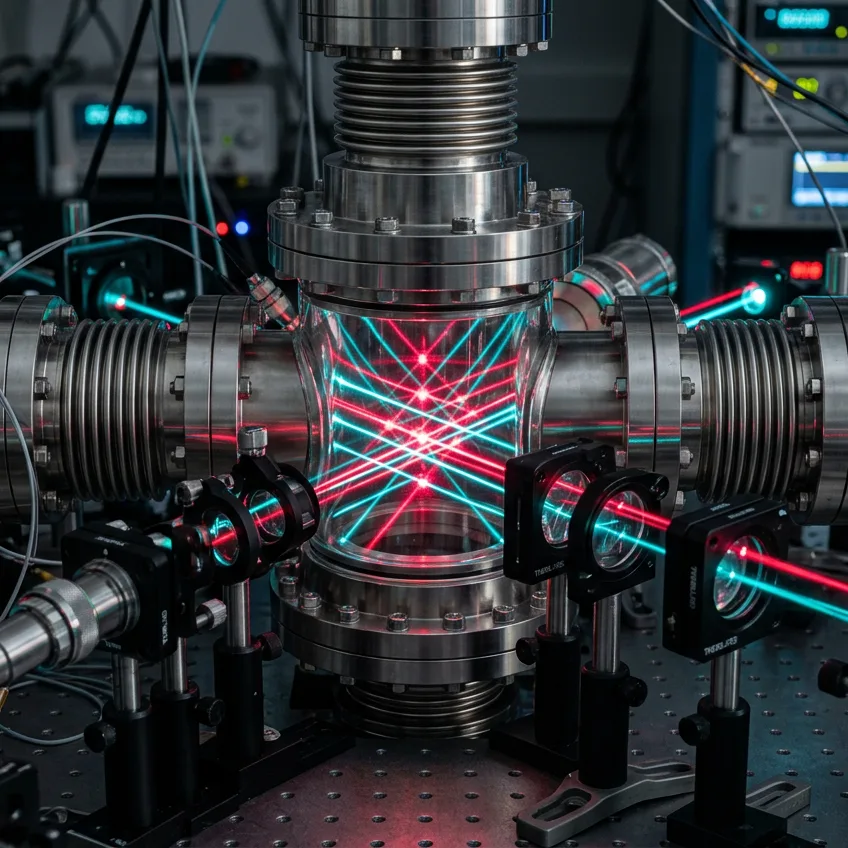
For over half a century, the official standard for the world's second has been governed by cesium atomic clocks, which oscillate at microwave frequencies. However, modern metrology has entered a new era with strontium optical lattice clocks, revolutionary devices that immobilize tens of thousands of atoms within a three-dimensional lattice woven from laser light.
By using visible light frequencies instead of microwaves, these systems 'tick' hundreds of trillions of times per second. Their quantum stability is so extreme that they would take more than 30,000 million years to gain or lose a single second, a span more than double the age of the entire observable universe.
This colossal sensitivity has turned these instruments into tools capable of testing the very fabric of spacetime. According to Einstein's Theory of General Relativity, time flows slower as an object approaches the center of a gravitational mass. In recent experiments conducted at centers such as JILA (NIST and the University of Colorado Boulder), researchers managed to measure the shift in the pace of time by raising the cloud of atoms just one millimeter inside the laboratory.
Beyond redefining the second, these devices inaugurate 'chronometric geodesy': a discipline capable of mapping the movement of volcanic magma, warning of tectonic stress before an earthquake, and attempting to hunt disturbances caused by elusive dark matter.
Source: Nature / JILA (National Institute of Standards and Technology & University of Colorado Boulder)